
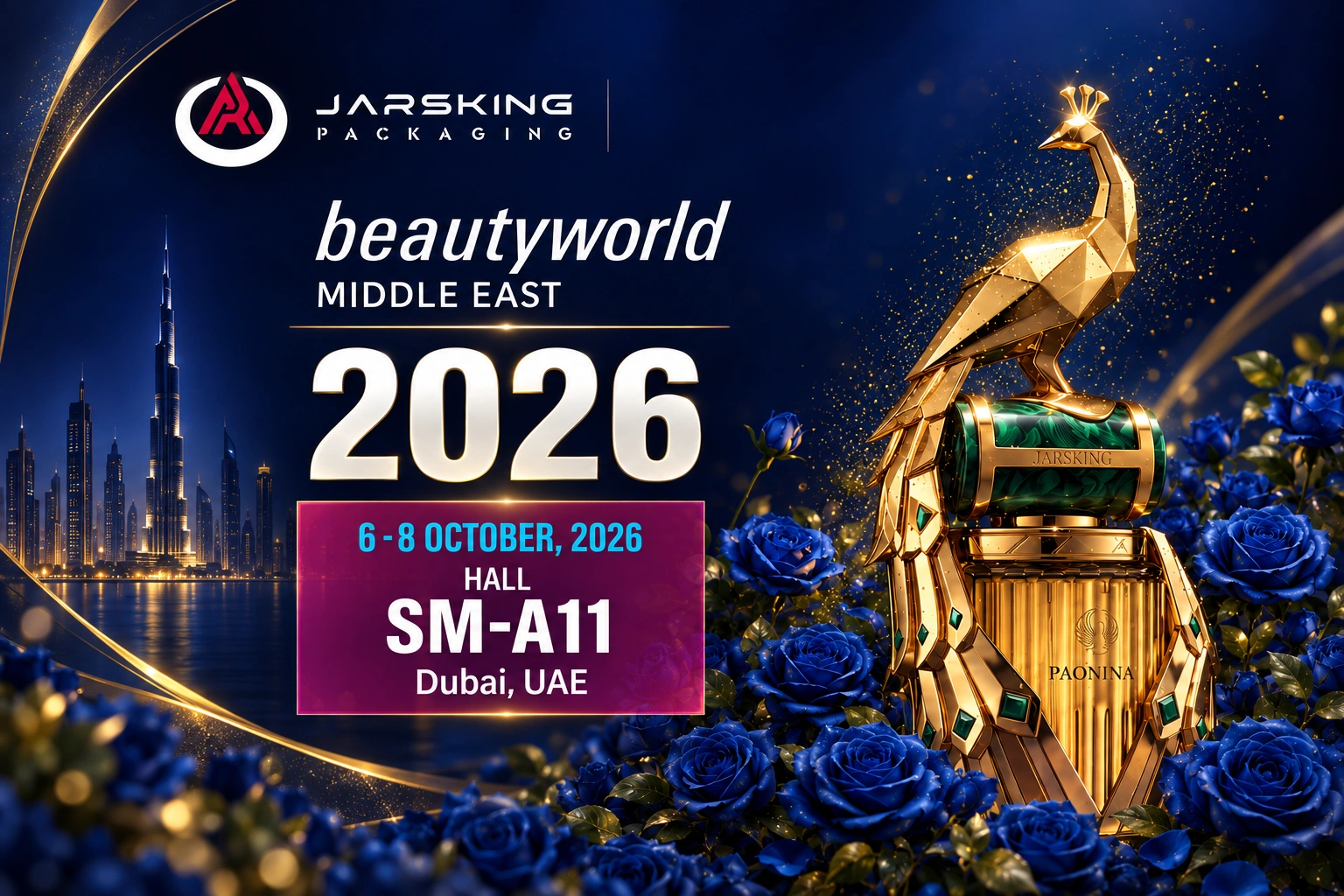


Beautyworld Dubai marks its 30th edition this October by rebranding from Beautyworld Middle East to Beautyworld Dubai, giving fragrance its largest dedicated footprint in the show’s history — a new hall at Za’abeel 7 with more than 220 fragrance exhibitors across 19,000 square metres.
Fragrance packaging ready to scale means a bottle, cap, pump, and decoration system that can be reproduced consistently across higher volumes, multiple sizes, several filling partners, and international markets — without redesigning components every time the brand grows. A design that performs well in one market can still fail once it has to survive global logistics and repeat production runs.
The rebrand itself signals the shift: organizers describe Dubai moving from a market international brands sell into, to one where brands are now built for the world. Middle Eastern fragrance houses are exporting oud, amber, and musk interpretations, layering rituals, and perfume oils to consumers who previously only encountered these ideas through niche retail.
That international pull creates a specific packaging question. A collection that performs well in Dubai, Riyadh, Kuwait City, or Doha can attract distributors and retailers abroad almost overnight — but the packaging behind it was often engineered for a single regional production run, not for multi-market, multi-SKU growth.
1. Why “It Looked Great at Launch” Isn’t the Same as Scalable
A packaging system is scalable when the same bottle, cap, and decoration standard can be reproduced consistently across higher volumes, multiple sizes, several filling partners, and different markets — without the brand redesigning components each time it grows.
This distinction matters more than it first appears. A hero bottle is developed to create an emotional reaction in campaign photography and retail displays. It’s judged on how it looks in one carefully lit shot. A scalable system is judged on a different set of questions: can the same cap concept work across a 30 ml, 50 ml, and 100 ml range? Will the pump perform consistently once filled with the actual formula, not a placeholder liquid? Can the decoration survive a shipping container instead of a photo studio?
Social platforms can introduce a fragrance brand to a new country almost overnight — a creator collaboration or a retail placement can generate inquiries from three continents within weeks. The packaging and supply chain behind that brand, however, is often still sized for a regional launch. When demand accelerates faster than the packaging system was designed for, brands typically run into the same unanswered questions: production consistency at higher volume, size extensions, travel or discovery formats, pump-to-formula performance, decoration durability in transit, market-specific labelling space, e-commerce-viable weight, and colour/finish consistency across repeat orders.
None of these are minor operational footnotes. A customer who receives a leaking bottle or a mismatched cap colour doesn’t file that under “logistics issue” — to them, the packaging failure is a brand failure.
2. Building the Packaging Architecture Before the Range Gets Complex
A brand that starts with one 100 ml Eau de Parfum can realistically need a 50 ml core size, a 30 ml entry size, a 10 ml travel spray, a 2 ml sample vial, a discovery set, a perfume oil version, a seasonal gift box, a retailer-exclusive edition, and a home-fragrance extension within two or three years. If each of these is developed independently, the range fragments visually and the component list multiplies — decoration standards drift, and packaging cost becomes harder to control.
The stronger approach is to decide, before the range grows, which elements must always stay recognizable — bottle silhouette, shoulder profile, cap geometry, logo placement, colour system — and which elements are allowed to change to differentiate individual fragrances, such as secondary decoration, cap inserts, plaques, collars, or box graphics. That separation is what lets a brand launch a dozen SKUs without looking like a dozen unrelated brands.
Portfolio Strategy Before Mold Investment
Custom tooling produces packaging that’s harder to imitate and more strongly tied to a single brand — but it’s a decision that should follow a three-to-five-year portfolio plan, not a single sketch of the launch bottle. Before committing to custom molds, it helps to work through a short set of questions:
- Which bottle capacities will the range realistically need?
- Can one cap concept extend across multiple bottle sizes?
- Will the line include both spray fragrances and oils?
- Is a discovery or gift set part of the near-term retail plan?
- Which components should be proprietary, and which can rely on dependable stock molds?
Not every part needs to be custom from day one. A well-chosen stock bottle paired with a custom cap, distinctive decoration, and considered secondary packaging can differentiate a growing brand while reducing both development time and upfront tooling risk. As demand proves out, more proprietary elements can be introduced in later phases.
3. What Regional Luxury Codes Cost When They Travel
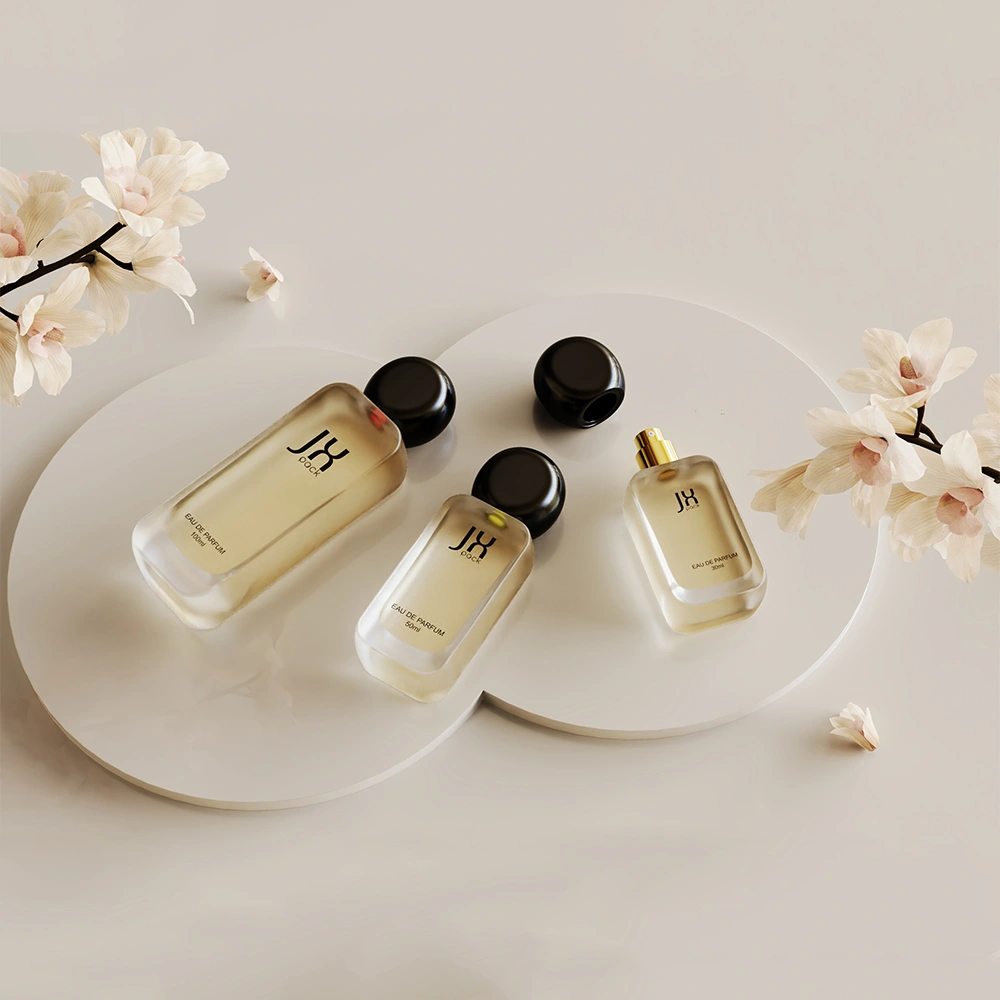
Middle Eastern fragrance packaging carries a distinct visual language — thick glass, substantial caps, metallic detailing, decorative plaques, and elaborate presentation boxes that signal ceremony before the bottle is even opened. None of that needs to disappear to suit a more minimal “global” aesthetic. But every one of those design choices carries a commercial consequence once the product starts crossing borders.
A heavier bottle feels substantial in hand, but it raises freight cost, e-commerce fulfilment cost, and the packaging’s carbon footprint per unit shipped. A large presentation box creates a strong unboxing moment, but it also consumes more warehouse and retail shelf space per unit sold. A highly complex cap looks distinctive, but each added part is another assembly step and another quality-control checkpoint.
The relevant question isn’t whether Gulf fragrance packaging needs to get lighter or simpler to succeed globally. It’s which specific design elements are actually creating perceived value, and which ones are only adding cost or risk without a matching return. Glass clarity, controlled wall-thickness distribution, precise proportions, cap alignment, consistent opening resistance, a clean spray pattern, and repeatable decoration all shape how premium a bottle feels — often more convincingly than raw material weight does. The cap’s closing sound, the surface texture, and how the bottle sits inside its box all contribute to that perception too. Brands that scale successfully tend to preserve the emotional richness of their design while quietly improving how repeatable and efficient the engineering behind it is.
4. One Fragrance Range, Several Packaging Formats
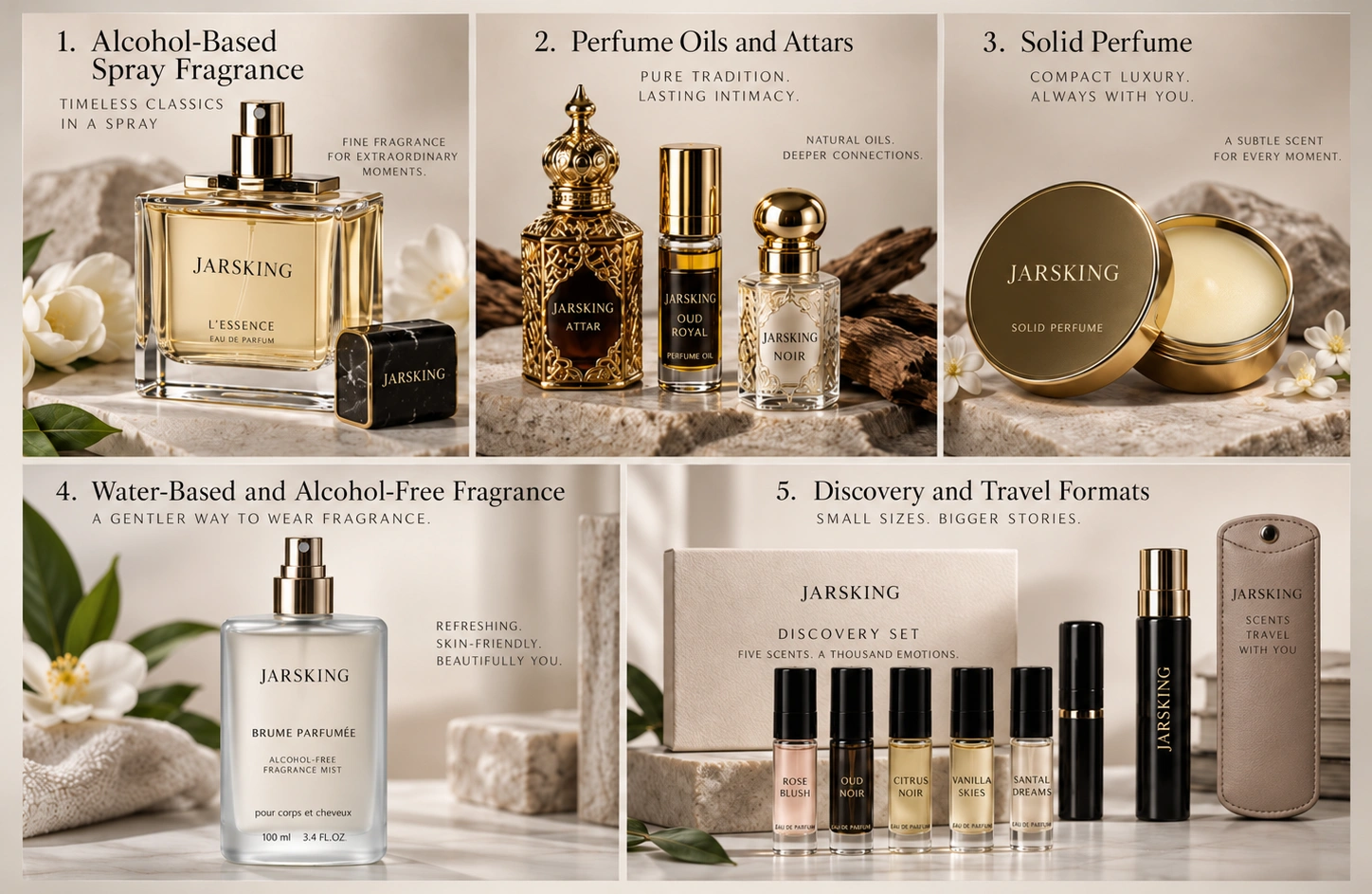
Fragrance categories are broadening well beyond the standard glass spray bottle, and Beautyworld Dubai’s 2026 content program reflects that directly — the Next in Fragrance stage runs a Day 3 session titled “New Formats, New Rituals: Exploring Layering, Solids, Water, Oils & Hybrids,” followed immediately by “The Evolution of Scent: Alcohol-free Fragrance and the Skinification Movement” . That sequencing is a useful signal: the industry conversation is actively moving past the single-format assumption, and packaging needs to move with it.
Each format below carries a different failure mode and a different set of variables worth checking before tooling is finalized.
Alcohol-Based Spray Fragrance
An Eau de Parfum or Extrait de Parfum depends on several components working together as a system rather than as isolated parts — the pump, the gasket, the dip tube, the bottle-neck finish, and the crimping or screw connection all have to hold up under sustained contact with ethanol and aromatic compounds. Ethanol concentration is typically the most aggressive stressor in the assembly. It can cause gasket materials such as certain nitrile or foam compounds to harden, shrink, or weep fluid over time, while dip tubes made from low-density polyethylene may elongate, curve, or become brittle when exposed to terpenes and aromatic esters found in many fragrance oils.
The spray mechanism introduces its own variables. A pump that primes and actuates correctly on an empty test rig can still behave differently once filled with a viscous or highly aromatic formula. Dosage consistency and atomisation pattern both need verification with the actual juice, not a placeholder liquid — a bottle with beautiful proportions and an inconsistent or harsh spray pattern will read as a lower-quality product the moment a customer uses it.
Perfume Oils and Attars
Oil-based fragrances typically use roller balls, applicator sticks, droppers, or controlled-flow inserts rather than a spray mechanism, and the central engineering variable here is the relationship between formula viscosity and component clearance. A roller ball seated too loosely against thin, low-viscosity oils will leak or drip, while a seat that’s too tight against a thicker oil blend will clog or roll poorly and frustrate the user. Getting this fit right requires evaluating oil viscosity at both room temperature and warmer transit temperatures, since oils can thin out significantly in a hot warehouse or a non-climate-controlled shipping container.
Leakage risk doesn’t stop at the roller ball itself. Oil can migrate into the cap threads or the tube shoulder if the inner seal is weak, and once it escapes the primary container, it can spread across labels and decorative surfaces in ways an alcohol-based spray rarely does. A cap that looked secure in a five-minute demonstration can still allow slow seepage over weeks of transit and shelf storage — which is why inverted-storage tests and temperature-cycling tests matter more for oil formats than they might for a spray bottle.
Solid Perfume
Solid perfume packaging is judged less on liquid containment and more on mechanical durability, because the product typically sits in direct contact with a metal tin, plastic compact, or similar vessel that gets opened repeatedly, often while travelling in a bag or pocket. Closure security matters more here than it does for a shelf-only display piece, since a compact that pops open inside a handbag creates a mess and a poor first impression that has nothing to do with the fragrance itself.
Surface durability is the second consideration. A tin or compact gets scratched, dropped, and handled far more than a boxed spray bottle typically would, so finish selection — matte, gloss, embossed, or metallic — needs to be evaluated not just for how it looks on day one, but for how it holds up after weeks of pocket wear.
Water-Based and Alcohol-Free Fragrance
Alcohol-free formulas usually replace ethanol with an oil-based carrier, an emulsion, a water-based system, or a gel, and each of these carriers interacts differently with plastics, gaskets, and decoration than a traditional ethanol-based perfume does. A component that’s been validated for years against alcohol-based formulas can’t be assumed to behave the same way against a water-based or emulsion-based carrier — the surfactants, preservatives, and water content introduce a different set of chemical stressors.
This is the format where testing with the actual formula matters most, precisely because there’s less established precedent to rely on. Material selection, preservation behaviour, and dispensing performance should all be validated against the real production formula rather than assumptions carried over from conventional alcohol-based perfume development.
Discovery and Travel Formats
Small vials and portable atomisers are frequently treated as a secondary priority because their unit value is lower than a full-size bottle, but this is often a mistake. For many customers — particularly those discovering a Middle Eastern fragrance brand for the first time through an international retailer or a sampling program — this small format is their only physical interaction with the brand before a purchase decision.
Accurate filling and reliable sealing matter as much here as they do on the flagship bottle, because a discovery vial that leaks in transit or under-fills relative to its stated volume damages trust before the brand has had a chance to make a real impression. A travel spray also still needs the same pump-to-formula compatibility verification as the full-size version, since a smaller format doesn’t reduce the risk of an inconsistent spray pattern — it simply reduces how forgiving customers will be about it.
5. Adapting for New Markets Without Diluting the Brand
International expansion usually means the packaging has to carry more information, not less. Languages, product descriptions, responsible-party details, barcodes, symbols, and warning statements can all vary by destination market and product category. Regulatory frameworks differ meaningfully between regions — the European Union, for example, requires a Responsible Person name and address on the label, together with nominal content, a date of minimum durability or a Period-After-Opening symbol, a batch number, and a full ingredient list in INCI nomenclature in descending order of predominance. The United States has its own labelling conventions under FDA rules, including net-quantity requirements and specific rules for how ingredient declarations may be presented. Since these frameworks are detailed legal requirements that vary by product category and change periodically, brands should always confirm current obligations with qualified regulatory specialists for each target market rather than relying on general industry description.
6. Why This Matters for Packaging Design, Not Just Compliance
From a packaging design standpoint, the practical implication is that the design needs enough flexibility to accommodate this information without the layout falling apart. If the original box uses every available surface for decorative graphics and brand storytelling, adding a second language, a responsible-party statement, or a market-specific symbol later can visibly damage the visual hierarchy the graphics were built around. If essential regulatory information is printed permanently onto an expensive component — such as a decorated glass bottle rather than a lower-cost label or carton — the brand may be forced to hold separate finished-goods inventory for each market simply to accommodate label differences, which increases both cost and complexity as the number of markets grows.
Planning Information Architecture Early
Brands can reduce this problem by deciding early which elements of the packaging system should remain universal across every market, and which elements are built to be adapted. Certain elements typically remain universal, including the logo, the core brand story, and the principal design system, since these define brand recognition regardless of where the product is sold. Other information is better suited to adaptation through market-specific cartons, labels, or controlled production versions, since these components can be updated for a new market without requiring a full redesign of the primary decorated component.
The goal is consistency without rigidity. A consumer in Dubai, London, Paris, New York, or Shanghai should recognise the same brand even where some printed information changes to meet local requirements. Global readiness doesn’t mean removing regional identity — it means building a system flexible enough to carry that identity across different commercial and regulatory environments, without forcing the brand to redesign its core packaging every time it enters a new market.
7. Where This Fits Into Beautyworld Dubai 2026
None of this changes the fundamental test a packaging system has to pass before it’s ready for international shelves. It has to remain recognisable across every SKU. It has to survive the actual formula, not a placeholder liquid. It has to move through a real filling line without constant manual correction. And it has to reach a customer in London or Shanghai in the same condition it left the factory in Dubai in. A brand that can answer the seven questions in this article with confidence is a brand that’s ready to have that conversation with international distributors, buyers, and retail partners — not just with its own regional customers.
At Jarskingglobal, we work with fragrance brands to connect creative ambition with manufacturing reality — from bottle and cap selection to custom structure development, decoration, dispensing systems, secondary packaging, testing, and production. If your team is mapping out a portfolio strategy, evaluating a pump-to-formula fit, or trying to figure out whether your current supplier can support the next five SKUs, that’s exactly the kind of conversation worth having before tooling gets locked in.
Meet Jarskingglobal at Beautyworld Dubai 2026, from 6–8 October 2026 at the Dubai World Trade Centre . Visit us at Booth SM-A11 to explore fragrance packaging systems designed for brand distinction, reliable production, and international growth.
Jarskingglobal — Packaging for Good. Designed for Growth.