
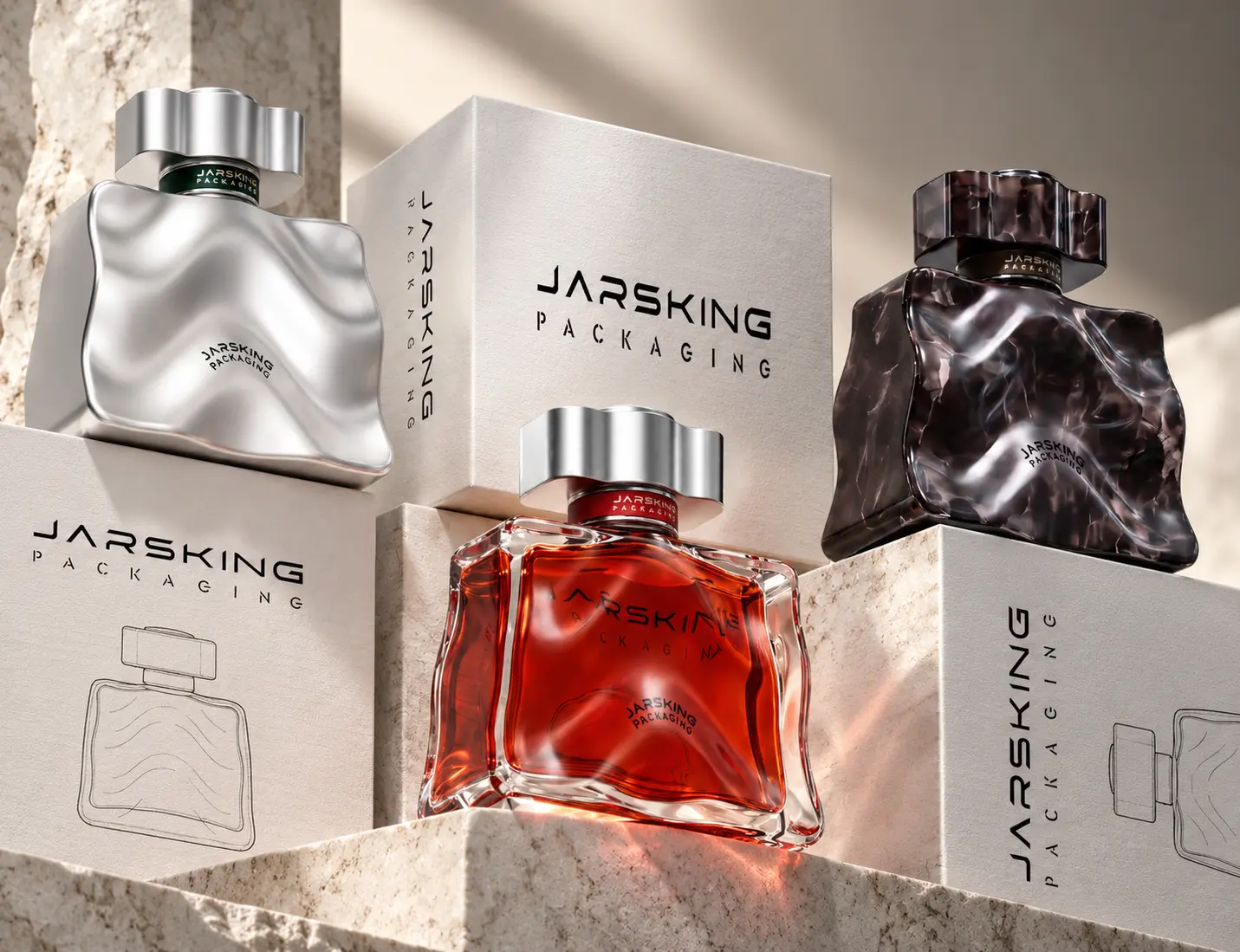


A bottle can look right in a rendering and still be difficult to decorate consistently. A gold logo may cross a curved shoulder. A gradient may hide the fragrance beautifully but vary noticeably between bottles. A soft-touch finish may feel perfect until it meets perfume residue.
Choosing perfume bottle decoration methods means resolving these questions before approving production—not after the artwork is finished.
Perfume bottle decoration methods are processes that add graphics, color, texture, metallic effects, or attached details to a bottle. Common options include silk screen printing, hot stamping, spray coating, frosting, metallization, decals, and engraving. The right choice depends on bottle geometry, artwork detail, production volume, layer compatibility, and the durability required during filling, shipping, and use.
The practical goal is repeatability: a finish that communicates your brand and can be reproduced within agreed limits.
1. Why Perfume Bottle Decoration Matters Beyond Shelf Appeal
Decoration gives a bottle its visual identity, but it also creates surfaces that must survive handling, packing, and fragrance contact. Treat appearance and performance as related requirements—not as the same approval.
Brand Identity Starts With a Consistent Visual Language
A clear stock bottle can support very different identities through an opaque coating, a restrained printed wordmark, or a reflective foil accent. Glass decorators offer these processes individually and in combination, allowing the same basic container to take on different visual characteristics.
For buyers, the useful question is not “Which process looks most expensive?” It is “Which process expresses the design without introducing unnecessary production risk?”
A simple front-panel logo may need only one printing operation. Adding a background coating, foil border, and applied plaque creates more relationships to control: position, color, adhesion, and assembly.
Tactile Effects Need Their Own Approval
A matte surface, raised printed detail, etched glass, and soft-touch coating can look similar in a photograph but feel different in the hand. Verescence, for example, distinguishes soft-touch lacquering, relief-effect screen printing, and acid-etched textures as separate decoration options.
Include touch in the sample review. Ask reviewers to handle the bottle with its cap fitted, rather than judging an isolated glass sample. Check grip, surface drag, visible fingerprints, and the transition between decorated and undecorated areas.
Decorative Coverage Is Not Proof of Fragrance Protection
Do not treat a frosted appearance or dark-looking finish as evidence that the fragrance is adequately protected from light. If light protection is part of the packaging brief, make it a separate validation requirement involving the actual decorated bottle and formula.
The same distinction applies to wear. A finish approved for color has not automatically been approved for alcohol resistance, rubbing, or packing friction; decoration testing commonly evaluates these properties separately.
2. Common Printing and Stamping Methods: Which Artwork Fits Each Process?
Silk screen printing suits defined graphics and solid colors. Hot stamping adds reflective foil accents. Decals offer another route for transferred artwork, but the transfer material and curing process must be identified before comparing performance.
Silk Screen Printing for Logos, Text, and Solid Graphics
Silk screen printing transfers ink through a patterned mesh onto the bottle. It is a practical starting point for wordmarks, product names, line illustrations, and limited-color designs.
However, “screen printed” does not describe a single ink system. Organic, UV-curable, and ceramic enamel systems use different curing mechanisms. Ink manufacturers offer organic glass inks with substantial chemical and mechanical resistance, so durability should not be judged from the printing-process name alone.
For artwork approval, request the decorator’s limits for minimum line width, smallest readable type, spacing between elements, and registration between colors.
Solid logos are generally easier to define than photographic shading. If a design depends on very fine detail or multiple closely aligned colors, ask for a print trial using the actual bottle—not a flat substitute.
Hot Stamping for Reflective Metallic Accents
Hot stamping transfers foil using heat and pressure. It is well suited to metallic wordmarks, borders, crests, and selected graphic accents. Some glass-decoration systems first screen print a receptive layer and then transfer foil onto that area.
This extra layer matters. The foil must work with the underlying print or coating, not merely look correct on its own.
Coverpla notes that bottle selection determines the available decoration surface and that minimum line thickness must be respected. It also recommends case-specific compatibility testing rather than assuming every formula behaves the same way.
Ask to see sharp corners, small lettering, and filled areas on the sample. Look for incomplete transfer, broken edges, unwanted foil pickup, and differences in reflectivity.
Ceramic and Water-Slide Decals: Clarify the Finished System
“Ceramic decal” and “water-slide decal” are not interchangeable descriptions. Ceramic refers to the decorative material and firing system; water-slide describes a transfer approach. A purchasing specification needs to identify both the transfer construction and how the decoration becomes fixed to the bottle.
Fired ceramic decoration and lower-temperature organic decoration have different material and processing requirements. A high-temperature ceramic operation cannot simply be added after an organic coating without checking compatibility; organic pigments do not withstand ceramic firing conditions.
For transferred artwork, ask whether a carrier edge remains visible, how the image conforms to curvature, and which subsequent operations the finished transfer can tolerate. Include edge visibility and placement in the approval criteria.
3. Surface Coating and Texture Techniques: Specify the Finish Behind the Look
Coating, frosting, and metallization change more of the bottle surface than a printed logo. Buyers should specify the actual process, coverage, and layer structure rather than relying on terms such as “matte,” “frosted,” or “metallic.”
Color Spraying and Gradient Coating
Color spraying can create transparent tints, opaque coverage, gloss, matte, and special-effect surfaces. It can also form the base for later printing or stamping.
For a solid color, define whether the glass and liquid should remain visible. A transparent blue and an opaque blue are different specifications even if both reference the same color family.
For a gradient, approve more than the two end colors. Define where the transition starts, where it ends, and which parts of the bottle must remain clear. Review bottles from the front, sides, and rear.
A useful sample set includes the intended appearance and proposed acceptable variation. One attractive sample does not establish the limits for a production batch.
Frosting and Acid Etching
Frosting describes an appearance; acid etching identifies one way to produce it. Acid etching modifies the glass surface, while an acid-etch-effect spray creates a similar visual result through an applied coating. Both routes are commercially available.
Ask the supplier to name the process explicitly.
Then confirm how later decoration will interact with that surface. Stoelzle notes that treated matte glass can be further decorated with screen printing and hot stamping, but the proposed combination still needs project-specific verification.
Judge texture, haze, fingerprints, and consistency around corners and shoulders. If the design combines clear and frosted areas, approve the boundary between them.
Electroplating and Vacuum Metallization
A metallic appearance can come from different systems, including metallic-effect lacquers and metallization. Do not use “electroplating” as a catch-all purchasing term for every reflective finish; decorators distinguish metallic lacquering from other decoration processes.
Ask whether the quoted effect is vacuum metallization, a plating system, or a metallic coating, and request the full layer sequence.
For purchasing purposes, the essential questions are practical: What prepares the glass? What creates the reflective effect? Is there a protective topcoat? Which areas are masked?
Approve metallic finishes under consistent lighting and at multiple angles. Add checks for scratches, pinholes, coverage boundaries, and visible handling marks to the inspection brief.
4. Specialty Embellishments: Separate Glass Features From Added Components
Engraving, molded relief, metal plaques, and decorative wraps introduce different development and assembly requirements. Evaluate each as part of the finished package rather than as an isolated visual detail.
Laser Engraving and Glass Embossing
Laser engraving is a post-forming marking operation. Molded embossing creates relief as part of the bottle’s glass geometry. They may both produce a permanent-looking identity, but they belong to different development stages.
For engraving, request trials showing contrast, detail, position, and the appearance through any existing coating. For molded relief, settle the feature during bottle development and confirm how it affects nearby printed or labeled areas.
A raised feature should not be treated as an ordinary smooth decoration panel. Surface shape, embossed areas, and uneven contact points need review before artwork approval.
Metal Labels and Custom Plaques
Metal plaques introduce an attachment system as well as a graphic element. Their position, curvature, edge condition, and bond to the bottle all need approval.
A label or plaque can be worth evaluating when the design requires a separate material identity or artwork that is inconvenient to reproduce through several direct-decoration passes. It does not eliminate surface constraints: curved panels, coating condition, adhesive bonding, and packing friction still need review.
Check the assembled bottle for lifting edges and interference with the cap, collar, or carton insert.
Wrapping, Ribbons, and Stones
These details should have an assembly specification. Define their location, orientation, attachment method, and acceptable variation.
Review them with the complete package. A ribbon must not obstruct the actuator, and an attached ornament must fit the protective insert without creating unwanted contact. Stability and friction during packing deserve their own checks, just as they do for badges and charms.
5. How Bottle Shape Limits Printable and Decoratable Areas
The available decoration area is the surface the chosen equipment can reach and reproduce consistently—not every visible part of the bottle. Bottle curvature, shoulders, seams, embossed details, and existing coatings should be reviewed before artwork is locked.
Flat Panels Still Need an Approved Working Area
A square bottle may offer a generous front panel, but artwork should not automatically extend to its edges.
Ask the decorator to mark a safe working area on the bottle drawing, with agreed offsets from corners, shoulders, the base transition, and mold seams. Request separate approval for front, back, and side decoration.
Also identify the reference used to orient the bottle. Front-to-back alignment cannot be judged reliably unless both parties agree on how the bottle is located during decoration.
Cylinders and Tapered Bottles Need Different Reviews
Rotary screen printing can follow cylindrical surfaces, with the bottle rotating during image transfer.
A tapered or compound-curved bottle requires a separate feasibility assessment. Do not assume a graphic proven on a straight cylinder will transfer unchanged.
For a wraparound design, ask about the start-and-stop gap, graphic distortion, and orientation relative to other components. For a faceted bottle, evaluate each face and the transitions between faces.
Shoulders, Recesses, and Raised Details May Need Another Process
Screen printing is not the only option for difficult areas. Pad printing is used for surfaces that are less accessible to a screen, including curved or recessed regions.
The choice may be to move the artwork, simplify it, use a different printing process, or evaluate a fitted label.
If you are still selecting the container, review the perfume spray bottle collection with your intended decoration panel in mind. Jarskingglobal’s category includes different bottle geometries and decoration options, making bottle selection and finish selection useful parts of the same discussion.
6. Perfume Bottle Decoration Methods Compared by Effect, Limit, and Verification
Use the desired effect to shortlist a process, then confirm its restrictions on the actual bottle. The checks below are proposed purchasing controls, not universal pass criteria; acceptance limits should be agreed for the project. Decoration reviews commonly separate adhesion, rubbing, solvent response, placement, and packing friction.
| Target effect | Suitable method | Main limitation to resolve | Verification items |
| Crisp solid-color logo | Silk screen printing | Printable panel, line detail, ink selection, color registration | Legibility, placement, opacity, adhesion, formula-contact response |
| Reflective gold or silver accent | Hot stamping | Transfer surface, fine lines, compatibility with underlying layers | Complete transfer, sharp edges, reflectivity, foil adhesion, rubbing |
| Multicolor transferred illustration | Decal system | Transfer construction, curvature, curing sequence | Image detail, visible edges, placement, edge stability |
| Transparent tint or opaque body color | Spray coating | Coverage, masking, compatibility with later decoration | Color, transparency, gloss, adhesion, contact resistance |
| Soft color transition | Gradient spray coating | Transition position and acceptable batch variation | Start/end positions, color density, front-to-back consistency |
| Frosted appearance | Acid etching or frost-effect coating | Different surface construction and subsequent-decoration behavior | Haze, texture, boundary definition, print or foil compatibility |
| Reflective metallic body | Specified metallization or plating system | Layer construction, masking, protective finish | Coverage, pinholes, scratches, adhesion, topcoat performance |
| Recessed or relief-style identity | Laser engraving or molded embossing | Contrast, geometry, development stage | Position, readable detail, consistency, nearby decoration fit |
| Separate metal identity element | Metal label or plaque | Curvature, attachment, assembly placement | Alignment, edge lift, attachment security, pack fit |
| Textile or ornamental accent | Ribbon, wrap, or attached ornament | Assembly variation and component clearance | Attachment stability, actuator clearance, packing friction |
7. Why Multiple Decoration Processes Need More Approval Stages
A combination finish must be approved as a complete layer system. Adding operations means checking not only each finish but also the interfaces between them.
A coated bottle with printed artwork and foil accents may involve cleaning, coating, curing, printing, further curing, foil transfer, inspection, and protective packing. The exact sequence depends on the selected materials; some foil systems rely on a printed receptive layer, while fired and organic decorations have very different thermal requirements.
A practical approval sequence is:
- Confirm the undecorated bottle, orientation reference, and workable decoration areas.
- Approve the base finish for color, coverage, gloss, and texture.
- Approve artwork detail and position on that finish.
- Review the complete production-intent sample, including all decoration layers and attached components.
- Test the assembled finish and proposed protective packaging before production release.
Ask who controls the interfaces if different companies perform different operations. A coating supplier’s approval does not automatically establish that a later ink or foil will adhere satisfactorily. Ink manufacturers specifically recommend suitability testing on the intended substrate before production.
Any material or process change after approval should trigger a review of the affected properties—not just a quick visual check.
8. How to Approve Appearance, Color Consistency, and Durability Separately
Use three connected approval records: appearance, color variation, and functional resistance. A visually correct sample is only one part of the decision.
Appearance: Define What an Acceptable Bottle Looks Like
Use a signed physical reference under agreed viewing conditions. Record artwork position, legibility, gloss, texture, foil coverage, and visible defect limits.
Include difficult areas rather than photographing only the best-facing panel. Shoulders, corners, coating boundaries, and attached-component edges often deserve close inspection.
Color: Agree on Variation, Not Just a Color Code
A color reference helps communicate intent, but the finished bottle also involves transparency, surface finish, glass geometry, and the liquid behind it.
Review transparent finishes with the intended fragrance where feasible, or with an agreed visual substitute. Establish acceptable lighter and darker examples if variation is a concern. If instrumental color measurement is used, agree on the measurement method and limits before production.
Organic glass inks can support corporate-color reproduction, but the final color still needs approval in the chosen application.
Durability: Test Realistic Contact and Handling
Build the test brief around expected exposure: fragrance drips, filling-line contact, handling, humidity, and friction against protective packaging.
Possible checks include:
- Adhesion testing appropriate to the coating or printed layer.
- Dry and wet rubbing with specified materials and conditions.
- Contact testing using the actual fragrance and relevant filling or cleaning fluids.
- Foil-edge, decal-edge, and plaque-attachment checks.
- Packing-friction evaluation with the proposed inserts and dividers.
Agree on the contact liquid, duration, rubbing conditions, and failure criteria. Do not adopt a generic wipe count without confirming why it suits the product.
Record results separately for each decorative element. A stable coating with a damaged logo is still a decoration failure.
9. Current Design Directions: Ask What the Finish Actually Changes
Water-based coatings, restrained graphics, and personalized finishes are useful development directions, but they do not remove the need for technical approval. Evaluate their specific construction rather than relying on trend labels.
Water-Based Coatings Need Specific Environmental Claims
Water-based lacquering is commercially established; Verescence states that its lacquers are water-based. Stoelzle also offers solvent-free decoration systems.
However, “water-based” alone does not establish the environmental performance of the complete decorated bottle. Ask which claim the supplier can document, and assess added layers, curing, attached materials, and disposal considerations separately.
Minimalist Designs Still Need Tight Execution
Fewer graphic elements can simplify a decoration brief, but they also leave placement, surface defects, and inconsistent color more exposed.
Keep the design restrained if it serves the brand. Do not assume restraint makes sampling unnecessary.
Personalized Finishes Need a Variable-Artwork Plan
If names, numbers, or interactive graphics change between bottles, identify which operation produces that variable content. Keep it separate from fixed artwork in the specification.
Approve the smallest readable details, positional limits, and any scanning requirement on the finished surface—not only on the digital file.
10. How to Choose a Production-Ready Decoration System
Choose the simplest process combination that delivers the intended identity and passes the agreed checks. Then compare quotations using the same bottle, artwork, layer sequence, and approval requirements.
Budget discussions should separate setup, decoration, assembly, testing, and protective packing. A lower unit decoration price is not a complete comparison if another quotation includes more operations or verification.
Before requesting samples, prepare the bottle drawing or model reference, editable artwork, desired finish references, quantity by design, formula-contact conditions, and proposed packing arrangement. Ask the supplier to identify the workable area and process limitations before final artwork approval.
At jarskingglobal, start that conversation with the bottle and the finish together. Share the visual effect you want, but also explain where the logo must sit, which surfaces customers will handle, and how the package will be filled and shipped. The brand’s perfume spray bottle page provides a relevant starting point for reviewing bottle forms and customization options.
Request decoration samples on the intended bottle, with the complete proposed finish sequence. That gives your team something more useful than a beautiful reference: a package you can approve for production.