
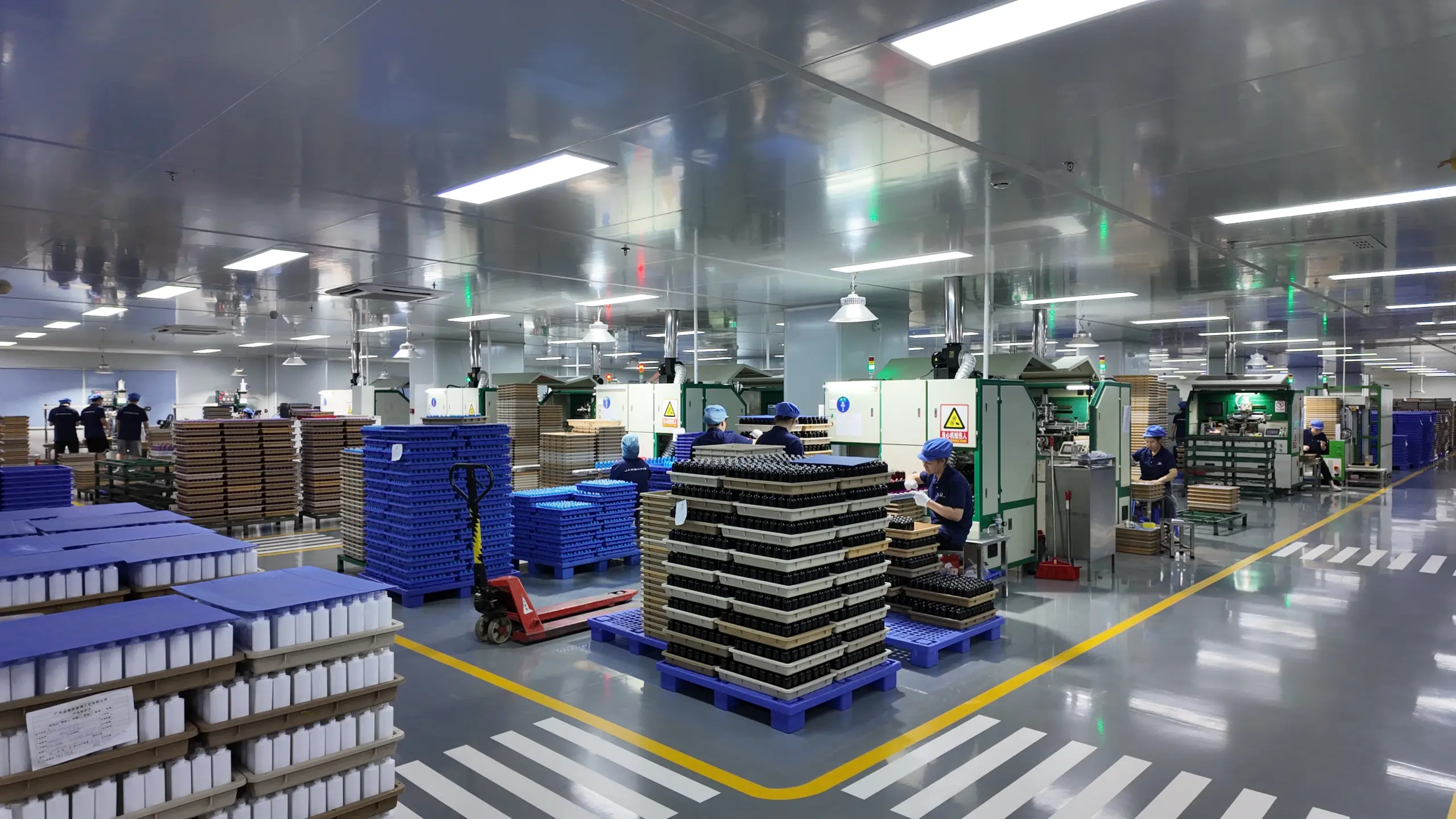


Here’s something nobody tells you when you’re launching a fragrance brand: your supplier relationship will make or break you long before a single customer smells your perfume.
I’ve seen it happen. A beautiful niche brand — thoughtfully formulated, well-branded, intelligently priced — collapses because 40,000 units arrive with pumps that clog after three sprays. The damage isn’t purely financial. It’s reputational. And in today’s social-media-amplified world, one unboxing video showing a leaking bottle can define a brand’s story for years.
That’s the uncomfortable truth behind the phrase “packaging is branding.” It’s not just about aesthetics. It’s about trust — and trust is built or destroyed deep in the supply chain, long before a bottle reaches a customer’s hands.
So whether you’re a fragrance startup, a private-label brand scaling to retail distribution, or an established house entering new international markets — this guide is for you.
1. Why Your Manufacturer Is Your Brand Partner (Whether You Treat Them That Way or Not)
Most first-time fragrance buyers enter sourcing conversations thinking about shapes, cap styles, and color palettes. Experienced brands have learned — usually the hard way — to think about something far less glamorous: engineering reliability at scale.
A sample can look flawless. The real test begins when 50,000 units are packed into sea freight containers and travel through humidity spikes, temperature fluctuations, and weeks of transit vibration. That’s when a 0.1mm tolerance failure in a neck finish becomes a catastrophic leakage problem. That’s when a pump sourced from an unverified component supplier starts failing after 800 actuations instead of the industry-standard 50,000+.
Here’s a reframe that changes how you evaluate every supplier: you are not buying a product, you are enrolling a manufacturing partner into your brand promise. Every decision they make — about glass wall thickness, about which pump brand to bundle, about how they handle a run of 500 defective units — directly reflects on your brand in the eyes of your end customers.
The difference between a reliable supplier and an unreliable one is almost invisible at the sample stage. It becomes brutally visible at mass production. That asymmetry is exactly why supplier evaluation deserves more rigor than most brands give it.
2. Step 1: Verify Real Specialization in Perfume Packaging — Not Just Glass Manufacturing
There is a critical distinction between a factory that can make perfume bottles and one that specializes in perfume packaging. Many glass manufacturers produce cosmetic jars, lotion dispensers, and generic containers — and list perfume bottles as a line item in their catalog. That doesn’t make them specialists.
Perfume packaging is not interchangeable with cosmetic packaging. Alcohol-based fragrance formulas interact with pumps, seals, adhesives, coatings, and crimped components in ways that water-based skincare products simply do not. A manufacturer unfamiliar with FEA15/FEA13 neck finish standards, crimp pump engineering, or the specific behavior of ethanol on metallic decoration is not a safe choice — regardless of how competitive their pricing looks.
The questions that reveal genuine specialization are precise ones. Ask: Which fragrance markets do you export to? Do you supply brands in Europe, the GCC, or North America? A supplier with active export relationships to the EU or Middle East is automatically held to stricter specifications by demanding international clients — and will demonstrate that experience through the depth and confidence of their answers.
Also ask about glass thickness calibration, atomizer compatibility, and alcohol-resistance testing for decoration finishes. A generalist will give you vague reassurances. A specialist will give you technical parameters.

3. Step 2: The Spray Pump Is Not a Commodity — Stop Treating It Like One
This is the single most underestimated element in fragrance packaging sourcing, and it’s where brands consistently make expensive mistakes.
Buyers spend weeks selecting bottle shapes and comparing decoration finishes, then accept whatever pump the manufacturer bundles in — often from an anonymous sub-supplier. The reasoning is usually cost-based. The consequence is almost always brand-damaging.
The spray pump is your customer’s first tactile experience with your perfume. A fine mist atomizer that delivers a consistent 0.10ml dose with smooth, silent actuation creates a luxury sensory impression that no bottle shape can compensate for. Conversely, a pump that spits large droplets, drips from the nozzle after use, requires excessive force to actuate, or loses pressure after a few weeks will cheapen a premium fragrance — regardless of how beautiful the bottle looks on a shelf.
This is especially consequential for niche fragrance brands, Arabic attars in fine mist formats, and travel-size fragrances where spray reliability is the primary functional promise.
Ask manufacturers specifically: Which atomizer brands do you work with? Can you provide spray cycle test reports? How do you validate pump performance with alcohol-based formulas? Professional manufacturers have standardized testing protocols and will answer without hesitation. Suppliers who deflect these questions with assurances like “our pumps are all high quality” are telling you they don’t actually control this variable.
4. Step 3: Decoration Durability Is More Important Than Decoration Beauty
Hot stamping, UV coating, frosting, electroplating, gradient metallization, silk printing — the modern fragrance market has elevated surface decoration to an art form. A walk through any luxury department store perfume section reveals just how dramatically brands differentiate through finish and texture.
But here’s what marketing catalogs and sample photos don’t show you: how that decoration performs after six months in a humid bathroom environment, after exposure to fragrance spillage during filling, after repeated handling by retail staff, after bouncing around in a customer’s travel bag.
Peeling logos. Fading gradient coatings. Metallic finishes that turn tacky when exposed to alcohol. These are real, documented failure modes — and they only become visible after you’ve committed to a production run and the brand damage is already done.
The right way to evaluate decoration capability isn’t to ask “can you do hot stamping?” — every supplier will say yes. Ask instead: “What alcohol-resistance testing do you perform on metallic finishes? Can I see production-line consistency samples from a run of 10,000 units? Can you show me a project where your decoration held through sea freight to Europe?”
Suppliers who take decoration durability seriously will have data. Those who don’t will give you polished but nonspecific answers. Learn to read that difference — it’s one of the most reliable quality signals in supplier evaluation.
5. Step 4: Understanding MOQ Flexibility for Brands at Different Stages
Here’s a tension every indie fragrance brand faces: you want manufacturing quality, but quality manufacturers often require volumes you can’t responsibly commit to in your early stages.
The 2026 fragrance packaging landscape has started to address this tension more creatively than it has in the past. Suppliers increasingly offer stock bottle customization — applying bespoke decoration (silk printing, hot stamping, frosting, custom cap colors) to existing mold designs at lower minimums, allowing brands to create a proprietary aesthetic without the $15,000–$50,000 investment of a new proprietary mold.
This is a smarter entry strategy than it might initially appear. It allows you to validate market reception, refine your visual identity, build production history and trust with a supplier, and generate real revenue — before you’re locked into a custom mold that commits you to a specific bottle architecture for years.
The questions to ask any potential supplier: What is the MOQ for stock bottles? What is the MOQ for custom mold development? Can decoration MOQ differ from bottle MOQ? Do you support small trial runs for market testing?
6. Step 5: Leakage Testing Is Non-Negotiable — Here’s the Technical Why
A single leaking bottle in an e-commerce shipment doesn’t just mean one return. It means a 1-star review describing a ruined handbag or stained clothing. It means a customer who will never return. And in today’s sharing economy of consumer reviews, it means the possibility of that experience being amplified across social media in ways that shape brand perception at scale.
The technical causes of perfume bottle leakage are more complex than most buyers realize — and that complexity is exactly why it requires systematic testing, not just quality inspection. Leakage problems involve neck finish tolerances, gasket material compatibility with alcohol-based formulas, crimp pump seating consistency, glass dimensional variation, and the interaction between all of these components under thermal stress and vibration during shipping.
Each variable has to be controlled independently and then validated in combination. This is why “we have strict quality control” is not a meaningful answer when you ask about leakage prevention. The right answer involves specific testing protocols: vacuum testing, transportation simulation testing, temperature cycling tests, and repeated spray cycle testing — all performed as standard production QC, not as exceptions triggered by customer complaints.
Ask manufacturers directly: What is your standard leakage testing process? What defect rate do you achieve? Can you provide QC documentation? Factories that avoid technical answers to these questions are almost certainly not performing rigorous testing. Treat that evasion as a serious disqualifier.

7. Step 6: Export Experience Is a Proxy for Operational Sophistication
A manufacturer that primarily serves domestic markets hasn’t been forced to develop the systems that international distribution demands. Reinforced carton standards. Pallet protection engineering for ocean freight. Documentation compliance for varying customs regimes across the EU, GCC, and North America. Temperature range testing that reflects the full journey a bottle might take from a factory in China or Eastern Europe to a distribution center in Texas or Dubai.
This matters more than it might seem on the surface. Suppliers with strong, consistent export records have typically been subjected to quality audits by demanding international clients — and those audits drive process improvements that benefit every client, including you.
Their communication is also typically stronger. The practical demands of managing international client relationships across languages and time zones force export-oriented manufacturers to develop clear documentation practices, standardized reporting, and proactive communication habits that domestically-focused suppliers simply don’t need to build.
When evaluating suppliers, ask: What percentage of your production is exported? Which regions do you regularly ship to? Can you provide references from clients in markets similar to ours?
8. Step 7: Sustainability Is Now Both a Market Expectation and a Regulatory Reality
The sustainability conversation around perfume packaging has moved decisively beyond consumer preference territory into regulatory mandate — particularly in European markets. The EU’s Extended Producer Responsibility frameworks and evolving packaging waste directives are creating real compliance pressure for any brand with European distribution ambitions.
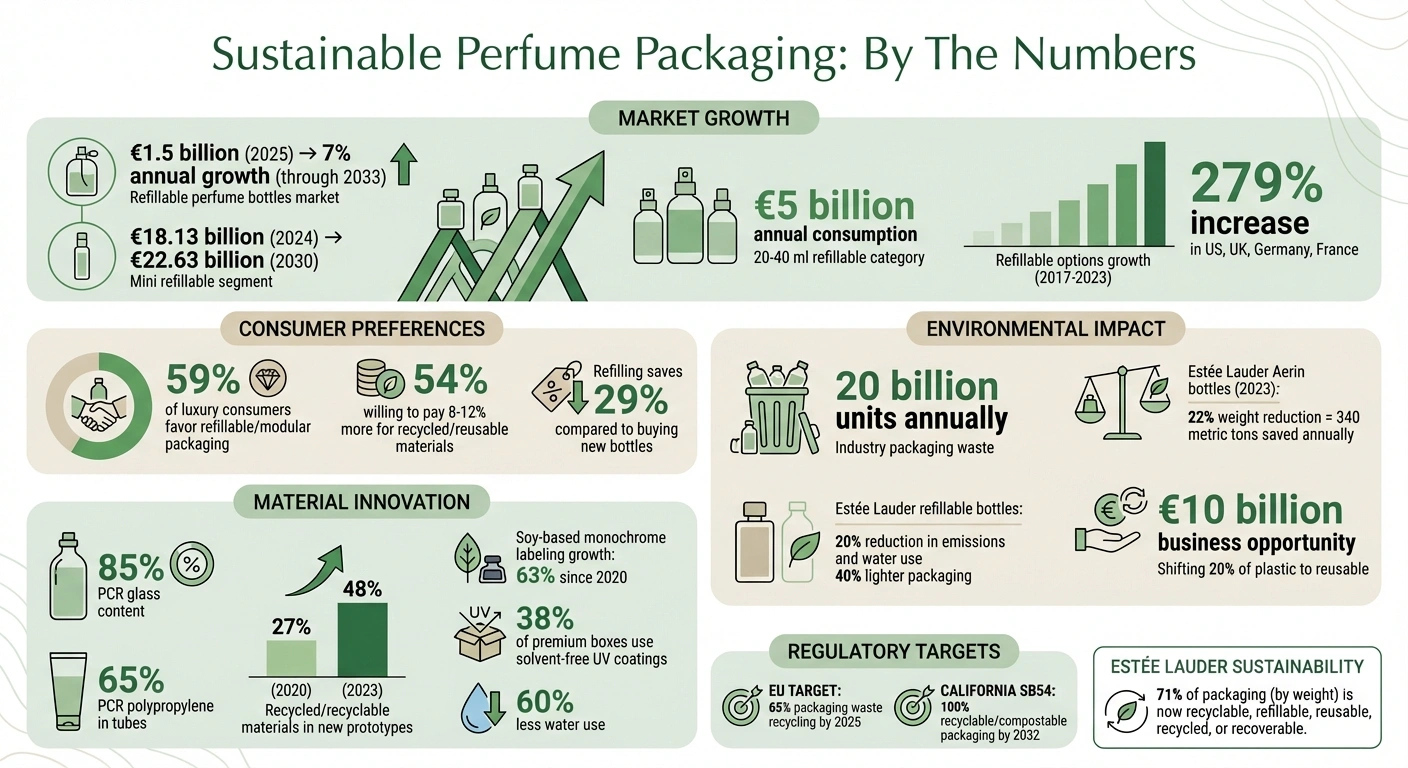
The numbers validate the urgency. Recycled or recyclable materials now represent 48% of new luxury fragrance packaging prototypes in 2026, compared to just 27% in 2020. Refillable fragrance systems have moved from niche novelty to mainstream expectation, with 59% of luxury buyers expressing a preference for refillable formats. Gen Z consumers — who now represent a critical and growing fragrance purchasing segment — actively factor eco-credentials into brand selection decisions.
The 2026 “lightweight luxury” design philosophy has emerged as the primary aesthetic response to these pressures: structural minimalism that reduces material weight and packaging footprint without compromising the premium sensory perception that fragrance brands depend on. This is now an area where your packaging supplier’s capabilities directly affect your brand positioning.
Ask potential manufacturers: Do you offer refillable bottle systems with standardized refill mechanisms? Can you supply PCR (post-consumer recycled) glass formulations? How do you approach eco-friendly decoration — water-based inks, reduced solvent coatings? Are you familiar with EU packaging compliance requirements?
A manufacturer who can’t engage substantively with these questions is already behind the market — and may create compliance problems for you in key distribution channels.
9. Step 8: Communication Quality Predicts Production Behavior
This point sounds soft. It isn’t. It’s one of the most predictive evaluation criteria available to you — and most buyers underweight it.
The way a manufacturer communicates during the sales process is a direct behavioral preview of how they’ll respond when production problems arise. And production problems will arise. The question is never whether you’ll face a challenge — it’s whether your supplier will notify you proactively at the first sign of deviation, or stay silent and deliver a defective batch hoping you won’t catch it until it’s too late to fix.
Reliable manufacturers answer technical questions with specificity. They provide realistic lead times — and explain the constraints that produce those timelines. They flag limitations before they become problems. They share production updates voluntarily. They maintain consistent, professional communication across time zones and through the less glamorous phases of a project.
Red flags that experienced buyers have learned to recognize: vague answers to technical questions, reluctance to schedule video factory tours, inconsistent quotations across multiple communications, promises of timelines that seem implausibly fast, inability to produce physical samples on reasonable timelines, and disappearing responsiveness after an initial quote is submitted.
Trust behavioral signals over catalog claims. A beautiful product brochure is easy to produce. Consistent, specific, proactive communication during supplier evaluation is harder to fake — and accurately predicts what you’ll experience during production.
10. Step 9: Previous Projects Tell You More Than Portfolio Photos
Supplier portfolios are curated to impress. That’s their function. What you actually need to evaluate is production-level consistency — and that requires looking beyond the polished hero shots.
Request production videos, not just sample photos. Ask to see filling-line compatibility demonstrations. Ask for references from clients who’ve been through a full production cycle, including any issues that arose and how they were resolved. Inquire specifically about projects that involved exported orders, custom decoration, or urgent timelines — the conditions under which execution gaps most clearly emerge.
Strong suppliers are proud of their technical capabilities and actively want to demonstrate them. The supplier who eagerly walks you through their production process, shows you a filling-line test, and connects you with existing clients is displaying confidence that comes from real operational quality. The supplier who defers these requests or provides vague process descriptions is likely avoiding scrutiny for a reason.
Also pay attention to decoration precision across multiple units in the same batch. Cap fitting consistency. Spray nozzle alignment. Glass color and texture uniformity. These are the variables that separate a production-capable manufacturer from one who produces good samples but struggles to maintain quality at volume.
11. Step 10: Price Is the Last Filter, Not the First
The cheapest perfume bottle supplier is almost never the cheapest solution over a full production cycle. It’s usually the most expensive one — once you fully account for rework costs, returned inventory, brand damage from product failures, emergency re-sourcing at premium rates, and the compounding financial impact of production delays on your launch timeline.
That’s not idealism — it’s risk-adjusted accounting.
The economic logic runs in the other direction, too. Premium, well-engineered packaging has a measurable multiplier effect on perceived product value. Luxury fragrance industry professionals consistently note that a beautifully finished, structurally sound bottle justifies retail price points that would be difficult or impossible to defend with mediocre packaging. The packaging is part of what you’re selling. Its quality directly influences how much a customer believes your fragrance is worth.
Evaluate suppliers in this sequence: technical capability first, then communication quality and transparency, then sustainability alignment, then pricing. Suppliers who pass the first three filters almost always deliver genuine value at their price point — because their cost structure reflects investment in real quality systems, not shortcuts that will surface later.
12. Red Flags That Signal a Supplier to Avoid
Over time, experienced fragrance brand managers have compiled a consistent list of warning signs:
Cannot explain technical specifications beyond surface-level descriptions
Refuses or deflects discussions about leakage testing and QC protocols
Provides inconsistent quotations across multiple communications
Avoids video factory tours or in-person audits
Lacks documented export experience to relevant international markets
Promises production timelines that seem significantly faster than industry norms
Cannot provide physical samples within a reasonable and agreed timeframe
Has no third-party certification (ISO 9001, SGS inspection records, or equivalent)
Any single one of these signals warrants scrutiny. Multiple signals should end the conversation.
13. What the Best Perfume Spray Bottle Manufacturers Actually Offer
Top-tier perfume packaging suppliers consistently deliver a combination of capabilities that spans the full production journey:
Custom bottle development with dedicated mold engineering support
Fine mist atomizer options from verified pump suppliers with documented testing data
Luxury decoration with durability validation across finish types
Documented leakage testing protocols as standard production QC
Low MOQ pathways through stock bottle customization for growing brands
Sustainable packaging options including refillable systems, PCR glass, and eco-decoration
Global export infrastructure with transit-tested carton and pallet standards
OEM/ODM services for brands that need full end-to-end development support
Most importantly, the best suppliers treat your brand’s growth as their own business interest. They invest in understanding your market positioning, your customer expectations, and your scaling trajectory — because your success is what makes you a valuable long-term client.
14. The Bigger Picture: You’re Building a Supply Chain Foundation
The fragrance market in 2026 rewards brands that treat packaging as a strategic platform — not a procurement line item. The independent fragrance brands gaining the most ground right now aren’t simply sourcing bottles. They’re building long-term production relationships with manufacturers who understand their positioning, their regulatory environment, and the quality standards their customers have been trained by luxury brands to expect.
That means the investment of time in supplier evaluation — the detailed questionnaires, the sample review cycles, the video calls, the factory audit requests — is not overhead. It’s product development. It’s brand building. It’s the infrastructure that makes sustainable growth possible.
In a market where customers increasingly judge a fragrance before they smell it, your packaging supplier’s reliability is not separate from your brand’s reliability. They are the same thing. Choose accordingly — and choose with the same intentionality you brought to developing the fragrance itself.