
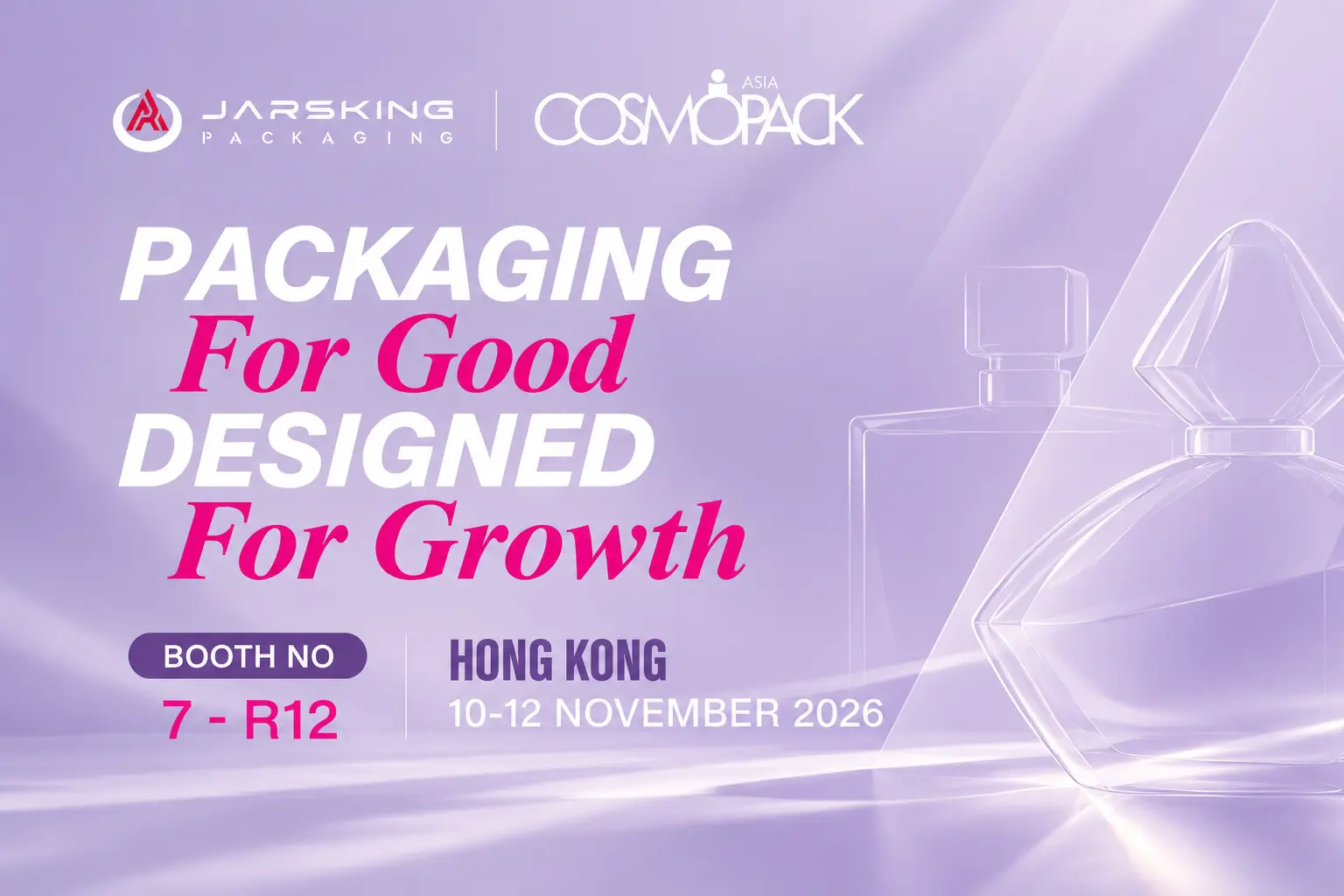


If you’re launching a perfume, adding another scent, or rethinking an existing collection, Cosmopack Asia 2026 is a chance to do more than browse bottles. It’s a place to discuss how the bottle, atomizer, cap, decoration, and box could work together—and what needs to happen before you place an order.
This article is about making that conversation useful. What should stay consistent across a fragrance collection? When is an existing bottle enough? What might justify custom tooling? And how do you prepare for another size without assuming the whole design can simply shrink?
Cosmopack Asia takes place November 10–12, 2026, at AsiaWorld-Expo in Hong Kong, bringing together suppliers across packaging, ingredients, contract manufacturing, machinery, printing, and labeling.
For fragrance brands, the connection is direct. The exhibition’s official COSMOLAB project, “Scent Utopia,” brings scent creation, bottle design, and packaging into one fragrance-development story.
That makes “Designed for Growth” a useful starting point. Not growth as a vague ambition, but the next move you can already see: another scent, a smaller format, a refreshed identity, or a packaging design that feels more like your brand.
1. Why Discuss Perfume Packaging at Cosmopack Asia?
There’s a difference between discovering a finished perfume and discussing how its packaging could be made.
Cosmoprof Asia at the Hong Kong Convention and Exhibition Centre focuses on finished beauty products, including perfumery. Cosmopack Asia at AsiaWorld-Expo covers the supply chain behind those products, including primary and secondary packaging. The two exhibitions have different dates and venues, so check which one your meetings are scheduled for.
If your questions concern bottle selection, component matching, decoration, or packaging development, Cosmopack is the relevant setting.
Fragrance Already Has a Place in the Programme
COSMOLAB 2026 provides a specific example.
Its “Scent Utopia” project presents “Forest in Motion,” an exclusive 30ml fragrance developed through a collaboration between Xuelei, CPL Aromas, Baralan, and PengYu. Their roles connect concept development, fragrance creation, glass packaging, and secondary packaging.
The interesting point is how those parts come together.
A scent needs an identity beyond its name. The bottle, cap, graphics, and box are opportunities to express that identity—but they also need to become an agreed package that can be sampled and evaluated.
That is the conversation to bring to your own supplier meeting.
You don’t need to settle every detail at the exhibition. You do need to understand which options deserve a closer look and what information is missing before the project can move forward.
2. Start With the Fragrance Brief, Not Just a Bottle You Like
A bottle reference is useful. It tells a supplier something about your taste.
But it doesn’t explain the whole project.
You may like the shape without wanting the same cap. The glass appearance might appeal to you while the proportions feel wrong. Perhaps the only detail you want to explore is the contrast between a clear bottle and an opaque closure.
Say which part matters.
Otherwise, “something like this” leaves too much room for interpretation.
Explain What You’re Launching
Start with a short description of the project.
Is this your first fragrance? A new scent joining an established collection? A redesign of packaging you already sell?
What capacity do you have in mind? Are additional sizes planned, or are they only a possibility? Which visual details are fixed, and where do you want suggestions?
Then cover the practical boundaries: expected quantity per product, budget direction, target market, and launch timing.
Jarskingglobal’s published perfume-bottle process asks for these details alongside references, component preferences, decoration requirements, and any box requirements. The purpose is to identify a suitable development route and the information needed for a meaningful quotation.
You don’t need all the answers before the first meeting.
You do need to distinguish an unanswered question from an approved requirement.
Describe the Mood, Then Make It Usable
Fragrance language can be wonderfully expressive. Packaging instructions need a little more precision.
“Quiet, warm, and understated” may help establish a direction. Follow it with something the team can discuss: limited decoration, a restrained color palette, or a particular relationship between bottle and cap.
The goal isn’t to remove emotion from the design.
It’s to give that emotion a form the project team can evaluate.
3. Think Beyond the First Scent
If another fragrance is already part of your plan, bring it into the discussion now.
You don’t have to design the entire collection. But you should ask how the first package might accommodate the next scent.
What will make the range recognizable? And what will help each fragrance feel distinct?
Those are related questions, not the same question.
Decide What the Collection Will Share
A common bottle shape is one option. So is a consistent cap, graphic layout, or decoration style.
For an illustrative three-fragrance collection, you might keep the bottle and typography while changing an accent color. Another approach could use different bottle colors connected by the same closure and artwork system.
Neither is automatically better.
The choice depends on the identity you want to build and the formats available for review.
Jarskingglobal describes extending a bottle design into additional fragrance products or editions through changes to color, decoration, and secondary packaging. That gives a brand options to explore without assuming every new scent requires a new structure.
Give Each Fragrance Enough Difference
A collection should look related. It should not make people work hard to identify which product they are holding.
Look beyond the logo.
Can the fragrance name be found easily? Is the difference between products clear in the proposed artwork? Does the design still make sense when the boxes are removed?
These are useful review questions before the design is approved.
Place the concepts beside one another. Compare the whole collection, not just the most attractive individual bottle.
If a second scent is coming, you may discover that the first design needs only a small adjustment. Better to notice that while it is still an artwork discussion.
4. Look at the Whole Perfume Pack
The glass bottle will probably attract your attention first.
Don’t let it finish the conversation.
The atomizer, collar, cap, decoration, and box all need a place in the proposed package. Choosing them separately without reviewing their relationship leaves important questions unanswered.
Jarskingglobal’s perfume-packaging information treats these elements as one system, with particular attention to neck compatibility, assembled proportions, cap alignment, decoration, and box clearance.
That doesn’t mean you need to arrive with a technical drawing of every component. It means asking to see what is actually being proposed together.
A Cap Is More Than a Finishing Touch
A cap may look right on its own and still need further review on the selected bottle.
Consider its proportion, its relationship with the collar, and how it aligns when closed. The intended opening and closing experience should also be discussed rather than inferred from a rendering.
Jarskingglobal’s published process includes evaluating cap dimensions, construction, fit, removal force, orientation, and clearance around the actuator and collar. The relevant requirements depend on the chosen design.
Keep the questions plain:
“Is this the cap being proposed for this bottle?”
“What still needs to be confirmed about the fit?”
“Will we review the assembled pack before approving it?”
Include the Box Before the Design Is Finished
If the project includes a box, bring it into the brief early.
What does it need to contain? Which bottle-and-cap combination is it being developed around? What presentation are you aiming for?
Jarskingglobal specifically identifies bottle clearance, cap clearance, and insert fit as matters to coordinate with secondary packaging.
The box should belong to the same project—not become a separate design exercise after every other decision has been made.
5. Know What Your Sample Can—and Cannot—Tell You
A sample is useful when everyone understands its purpose.
It might demonstrate the shape. It might show the decoration direction. It might represent the assembled components proposed for the order.
Those are not necessarily interchangeable.
Before approving anything, ask what you are looking at.
Is the capacity correct? Is this the intended material? Are the components the proposed production combination? Is the finish representative, or is it only a reference?
Don’t Confuse a Prototype With Production Glass
For custom development, a prototype can help you assess shape and proportions without reproducing every characteristic of the final glass.
Jarskingglobal notes that a prototype may not reproduce the production bottle’s final weight, clarity, or surface quality. Its process separates physical design review from approval of production-molded samples.
That is an important distinction.
A prototype can answer, “Do we like these proportions?”
It may not answer, “Is this exactly how the manufactured glass will look and feel?”
Know which decision you are making.
Agree on the Remaining Checks
A good-looking empty sample is not the whole evaluation.
Jarskingglobal describes project-specific checks involving the assembled bottle, components, decoration, formula exposure, and distribution conditions. It also states that not every project requires every test; the relevant methods and acceptance criteria need agreement.
Ask what should be evaluated for your particular package and who will handle it.
If compatibility evaluation is required, Jarskingglobal’s guidance calls for the actual fragrance formula and an appropriate production sample.
The practical lesson is simple: approving the appearance and approving the complete package are different decisions. Keep them separate until the required work is done.
6. Smaller Formats Need Their Own Design Review
A sample vial, a compact perfume bottle, and a full-size bottle can belong to the same brand without being identical objects.
Start by asking what the smaller format is meant to do.
Is it for sampling? A discovery set? A separate retail product? Those answers belong in the brief before you choose its appearance.
Jarskingglobal publicly lists several sample and compact perfume formats, including a product page covering 3ml, 5ml, 10ml, and 15ml options. These listings establish possible formats to discuss—not a guarantee that a chosen full-size bottle exists in matching smaller versions.
Carry the Identity Across
The task is to decide which details matter most.
You might keep the typography and color while simplifying the decoration. You might use a different structure with a related cap or coordinated box.
A smaller product should still feel connected to the main collection. It doesn’t have to reproduce every feature.
This is also where the artwork needs another look.
How much space is available? Which information must be included? Does the layout remain readable at the intended size?
Don’t approve a reduced digital image and assume that settles the physical package.
Ask About Availability Before Promising a Family
If several sizes are important to the launch, make that clear early.
Ask which suitable formats are available, what components they use, and where the appearance may differ.
You can then decide whether those differences fit the brand—or whether another packaging direction would give the collection a better foundation.
7. When Does Custom Perfume Packaging Make Sense?
A custom bottle can give a project a distinctive direction.
But “we want something unique” is only the start of the brief.
What should the new design achieve that an available format cannot?
Perhaps a particular silhouette matters to the brand identity. Perhaps a selected component or structural detail is central to the concept. Explain the need before deciding how much new development it requires.
Compare the Routes, Not Just the Renderings
Jarskingglobal offers both existing-mold and custom-development routes, with decoration and component choices forming part of the discussion. Its published process links the route to capacity, proportions, component requirements, quantities, and timing.
A useful comparison looks like this:
| Route | What you want to change | What to discuss |
| Decorate an existing bottle | Color, graphics, finish, or presentation | Suitable processes, artwork area, samples, and order requirements |
| Customize selected components | A cap, collar, or another defining detail | Fit, tooling, assembly, finishes, and evaluation |
| Develop a custom bottle | The structure or silhouette | Design work, tooling, trial samples, quantities, ownership, and timing |
These routes are not levels on a prestige ladder.
An existing bottle with a well-resolved cap and decoration may fit the brief. A custom structure may be justified when its purpose is clear.
Be Honest About the Commitment
Before choosing tooling, ask what the development involves.
Which approvals come first? What happens if the structure changes? What arrangements apply to the tooling and design? What needs to be confirmed before bulk production?
Avoid judging the decision by the rendering alone.
The attractive image is part of the proposal. The development work behind it deserves equal attention.
8. Compare Prices After You Compare What Is Included
Price matters. A package that doesn’t fit the business needs another discussion, however good it looks.
But before deciding that one quotation is cheaper, check whether it covers the same proposal.
Are the bottle and components comparable? Is decoration included? Are the quantities the same? What box or packing requirements have been assumed?
Then clarify any separate charges and responsibilities.
You do not need an elaborate spreadsheet for every enquiry. You do need a clear description of what you are buying.
Discuss Quantities by Product
A fragrance collection may launch together without being reordered together.
Ask how minimum quantities apply to each bottle, finish, component, or product. Don’t assume one general number answers every variation.
Be equally clear about forecasts.
“We hope to add three fragrances” is useful planning information. It is not the same as an approved order for three fragrances.
A supplier can discuss both, provided the distinction is visible.
Ask About Reorders Before the First Order
What records will serve as the reference when you order again?
Jarskingglobal identifies the approved bottle specification, artwork, color reference, and production information as part of maintaining continuity for repeat orders. It also advises checking for changes to components, decoration, quantities, boxes, and destination requirements.
That is worth discussing now, not only when the next purchasing deadline arrives.
9. Make Your Exhibition Meeting About Your Project
At Cosmopack Asia, give yourself a reason to move beyond “What else do you have?”
Bring enough information for the supplier to narrow the options.
Your meeting brief can be short:
- Current packaging or clear photographs.
- A description of the launch, addition, or refresh.
- Reference images with notes explaining what matters.
- Intended capacities and any likely additional formats.
- Expected quantities and budget direction.
- Target timing.
- The questions your team has not answered.
You don’t need a finished design. You need an understandable starting point.
Ask for Choices You Can Evaluate
Instead of requesting more and more options, ask which two or three directions deserve review.
Which available bottle formats fit the brief? Which component combinations could work? What requires further development? What is missing before a meaningful quotation can be prepared?
Some answers will need to come later.
That is fine. The meeting should identify the next piece of work, not pretend to replace it.
Leave With a Defined Next Step
A useful result might be a shortlist, a sample request, or a question assigned for technical review.
Confirm what each sample is intended to demonstrate and what information both sides need to provide.
A brief written recap after the exhibition helps keep the discussion clear:
What was proposed? What remains provisional? Who is doing what next?
An interesting meeting becomes useful when it leads somewhere specific.
10. Bring the Fragrance You’re Planning—and the Questions Behind It
You don’t need to design an entire future collection before launching your next perfume.
But if another scent or size is already part of the plan, bring it into the conversation now.
That may lead to a custom bottle. It may lead to a more considered use of an existing format. It may reveal that the bottle is right and the real work lies in the cap, decoration, or relationship between products.
Let the brief decide.
Jarskingglobal’s supplied exhibition invitation lists Booth 7-R12 for November 10–12, 2026, in Hong Kong. The official Cosmopack Asia venue is AsiaWorld-Expo.
Bring what you use now. Show the direction you are considering. Explain what you want to keep—and what you are ready to change.
The aim is not to leave with the largest collection of samples.
It is to leave knowing which packaging direction is worth developing, what still needs checking, and how to take the next step.