


Let me tell you about the phone call I dread getting from new fragrance founders. It usually starts the same way: “I found this gorgeous custom bottle design, and I just need to place the order.” Then I ask about their MOQ budget, and there’s this long, uncomfortable silence on the other end. That silence tells me everything I need to know about how this conversation is going to go.
Here’s the thing about perfume bottles that nobody explains clearly enough — this isn’t really a design decision. It’s a financial decision wearing a design costume. And if you get it wrong, you can burn through your entire launch budget before your fragrance ever reaches a customer’s nose. I’ve watched it happen too many times to count: a founder falls in love with a rendering, commits emotionally before checking the numbers, and then spends the next six months scrambling to make the math work retroactively.
So let’s actually sit down and talk this through properly — the way I would with a founder across a coffee table, not the way a rushed spec sheet would.
1. Why This Decision Feels So Much Harder Than It Should
I think the reason this particular question keeps people up at night is that perfume packaging carries more emotional weight than almost any other beauty category. Think about it — nobody cries over a shampoo bottle. Nobody keeps an empty conditioner container on their bookshelf as a memory object. But a perfume bottle? That’s the thing someone keeps on their vanity for years after the juice has completely run out. That’s the object they photograph for Instagram before they’ve even sprayed it once. That’s the physical proof that a scent memory existed at all.
Fragrance packaging sits at the very top of a brand’s storytelling hierarchy, and it’s expected to carry distinctive silhouettes, elaborate caps that might combine metal and resin, and secondary packaging like rigid boxes that make unboxing feel like a genuine event rather than just opening a shipment. So of course founders feel intense pressure to go custom immediately — right out of the gate, before they’ve sold a single unit. The bottle isn’t just holding the product in fragrance; the bottle basically IS the product, emotionally speaking, in a way that doesn’t apply nearly as strongly to a serum or a moisturizer.
But here’s my honest, slightly unpopular opinion after watching dozens of brands go through this exact crossroads: that emotional pressure is precisely what leads people to make the wrong financial choice at the wrong time in their brand’s life. Wanting something special and being financially ready to fund it are two completely different things, and confusing the two is probably the single most common mistake I see in this industry. Desire moves fast. Cash flow moves slow. When those two speeds collide, bad decisions happen.
2. What “Stock” and “Custom” Actually Mean
Let me strip away the jargon for a second, because I think a lot of the anxiety around this decision comes from people not fully understanding what they’re actually choosing between.
A stock bottle is basically a mold that already exists. Somebody else — a glass manufacturer, usually — paid to design and build that shape years, sometimes decades, ago, and now it’s sitting in a supplier’s catalog, available to any brand willing to place an order. You’re essentially renting a shape. You don’t own it, you never will, and other brands, including possibly your direct competitors, can and do use the exact same bottle for their own fragrances.
A custom bottle means you’re the one funding a brand-new mold from absolute zero. You (or your design team) sketch the shape, work with an engineer to make it manufacturable, pay for the physical tooling to be machined, and once that tooling is built, that mold belongs to your brand and only your brand.
The practical differences between these two paths cascade outward from that one core distinction, touching everything from your cash flow to your launch calendar:
Opting for off-the-shelf bottled products entails significantly lower financial risk and offers much faster delivery times; with minimum order quantities typically starting at 5,000 units, the volume remains manageable even for first-time entrepreneurs.
Custom bottles demand a serious upfront tooling investment that can run into the thousands of dollars before a single finished bottle even exists, with MOQs frequently starting around 10,000 units and climbing well past 50,000 for more complex shapes.
There’s also a middle option — semi-custom — where you keep a stock glass base but personalize it with a unique cap, embossed labeling, colored glass tinting, or custom surface finishing, which gives you a genuinely distinct look without the mold bill attached.
Honestly, that third option gets overlooked way too often in these conversations. People think it’s either “boring, generic stock” or “expensive, exclusive custom,” when in reality there’s an entire spectrum of options sitting comfortably in between those two extremes, and most brands would benefit from spending more time exploring that middle ground before committing to either pole.
3. The Timeline Truth That Catches People Off Guard
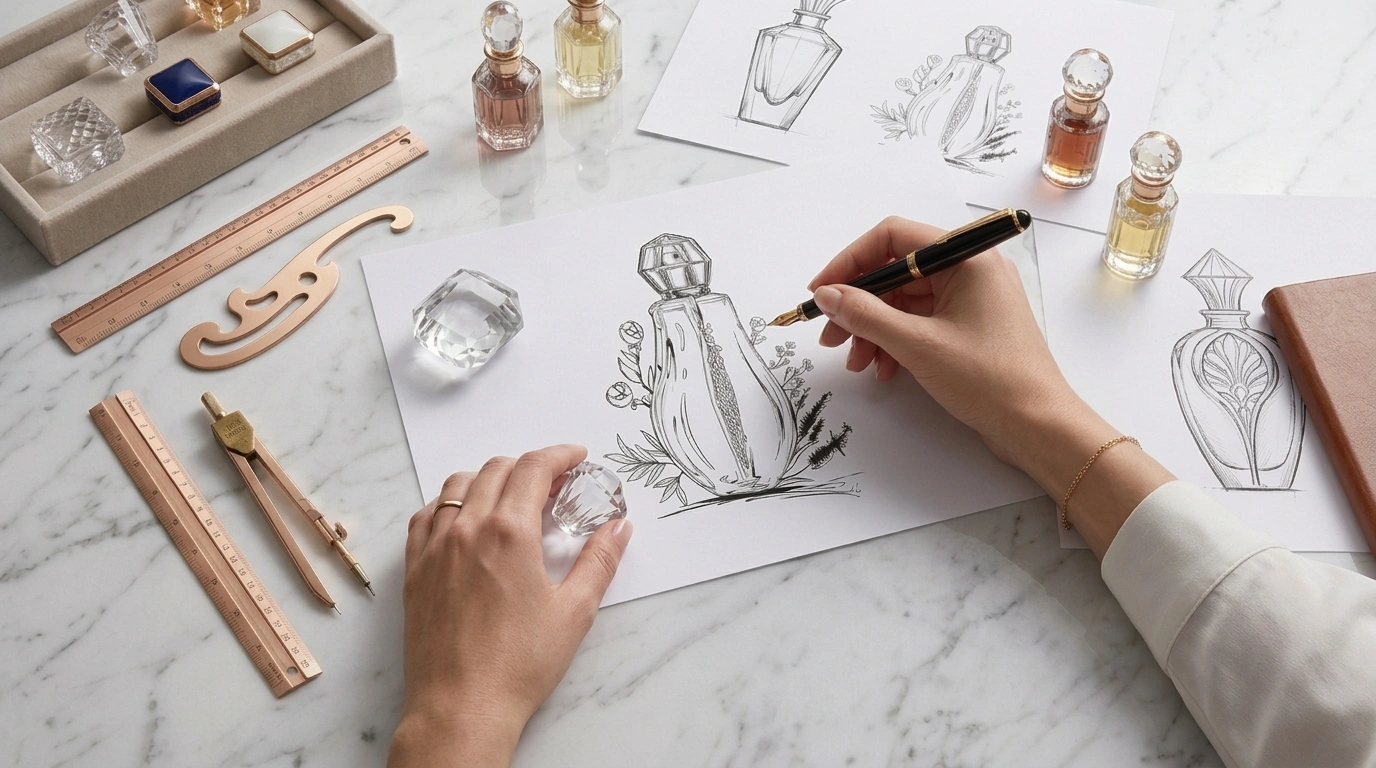
I want to be blunt about something suppliers don’t always volunteer upfront, mostly because it’s not exactly a selling point: custom bottles take a genuinely long time to bring into existence. We’re talking 14 to 20 weeks total from the moment your design gets finally approved to the moment finished bottles actually land in your warehouse ready to fill — and that window includes 6 to 8 weeks just for the physical mold itself to be engineered and built, plus another 2 to 4 weeks for sample rounds, adjustments, and final approvals before mass production even starts.
Do the math on that for a second. If you’re reading this in July and quietly dreaming of a holiday season launch, and you haven’t even started the mold conversation with a supplier yet, you’re already cutting things painfully close, if not past the point of realistic recovery. I’ve personally watched brands miss entire seasonal windows — Valentine’s Day, Mother’s Day, back-to-school, holiday gifting — because they underestimated this timeline by a couple of months and simply ran out of runway. Stock bottles, by comparison, move in weeks rather than months, which means if your launch date is fixed and genuinely non-negotiable, stock isn’t just the cheaper choice, it might honestly be the only realistic one available to you.
This is the part of the decision that pure design instinct can’t help you with. No matter how beautiful your custom concept is, it doesn’t matter if the bottles physically cannot arrive before your launch date. Timeline constraints have a way of making decisions for you whether you like it or not.
4. The Money Conversation Nobody Wants to Have
Let’s just say it plainly, because vague language helps nobody here: custom perfume bottles are expensive at low volume, full stop. You’re not just paying for glass — you’re paying to amortize a brand-new mold that hasn’t earned its keep yet through years of production runs. That tooling cost gets spread across however many units you order, which means at low volumes, your per-bottle cost can be shockingly high compared to what you’d pay for the exact same size and weight in a stock format.
Suppliers themselves have started admitting this openly, which tells you something about how common the mistake has become. One glass manufacturer said plainly that they’ve watched brands “spend months and tens of thousands of dollars on custom molds, only to realize they could have launched faster, tested the market sooner, and saved budget by starting with a stock perfume bottle.” And here’s the detail that really stuck with me when I first read it — many of those brands never even switched back to custom later, because stock simply worked well enough for what their actual business needed.
That last point deserves more attention than it usually gets. There’s this pervasive assumption floating around fragrance startup circles that stock is just a temporary stepping stone, a compromise you tolerate until you can “graduate” to the real thing with custom molds. But plenty of successful, genuinely profitable fragrance brands never make that switch at all. They stay on stock bottles indefinitely, year after year, and instead pour their differentiation budget into decoration, scent formulation, storytelling, and marketing — areas where the return on investment tends to be far more direct and measurable.
5. The Misconception That Stock Means “Cheap Looking”
I want to push back hard on something I hear constantly in this space: the idea that choosing a stock bottle automatically makes your brand look generic, cheap, or unfinished. That’s just not true anymore, and honestly, it hasn’t been true for quite a while now.
Decoration has become the real battlefield for differentiation in the fragrance world, not the raw glass shape itself. Hot stamping, screen printing, laser engraving, UV coating, matte frosting — these techniques can take a completely off-the-shelf bottle and transform how it feels sitting in someone’s hand, how it catches light on a bathroom counter, and how it photographs under studio lighting for a product page. These aren’t minor cosmetic tweaks either; they can genuinely change a customer’s entire perception of the product’s price point without touching the underlying mold at all.
And then there’s the cap and pump finish, which people underestimate constantly when they’re deep in the design process. A chrome finish, a matte black cap, brushed gold, rose gold, weighted metal accents — swapping out these details changes the entire personality of a bottle, sometimes dramatically, without requiring a single dollar spent on new glass tooling. I’ve seen the exact same stock glass bottle used by three different brands look completely unrelated once each one applied its own cap treatment and surface finish.
Ask yourself this honestly: if a customer picked up two bottles side by side, one built on a custom mold and one built on a stock base but beautifully decorated, would they actually be able to tell the difference just by looking at them? In most cases, genuinely, no. What they’d actually notice is the weight of the glass in their hand, the quality and consistency of the pump spray mechanism, and how the surface finish catches the light — none of which require you to own the mold underneath.
6. So When Does Custom Actually Make Sense?
I’m not here to tell you custom is always a mistake, because it absolutely isn’t for the right brand at the right moment in its growth curve. If your fragrance line has moved well past the validation stage and you’re seeing consistent, repeatable order volume month after month, the math genuinely starts flipping in your favor. At sufficiently high order quantities, the per-unit cost of custom glass becomes legitimately competitive with stock pricing, because that upfront tooling cost gets spread across so many units that its impact per bottle shrinks dramatically. And unlike a rented stock shape, you get to keep that custom mold as a long-term brand asset that appreciates in value as your brand recognition grows.
There’s also a strategic dimension to this decision that goes beyond just optimizing a single bottle in isolation. As fragrance brands mature and grow into full product portfolios — expanding into body mists, home fragrance diffusers, rollerballs, travel-sized sprays — many packaging partners now support coordinated custom development across an entire product family at once. This keeps caps, sprayer mechanisms, and dropper components visually consistent across every SKU, so the whole line reads as one unmistakably cohesive brand rather than a patchwork of unrelated containers pulled from different catalog pages. That kind of unified design language is genuinely difficult to fake using stock components sourced from different suppliers at different times.
So when do I personally tell founders it’s finally time to go custom? Usually when three specific things line up simultaneously: you’ve got proven, repeatable sell-through on your current product lineup over a meaningful stretch of time, you have the actual cash reserves to fund tooling without starving your marketing and inventory budgets in the process, and your brand identity has matured enough that you genuinely know what shape represents you rather than guessing. Chasing custom before all three of those conditions are truly met is exactly how promising, well-loved brands run out of financial runway before they get the chance to properly scale.
7. The Regret Pattern I See Over and Over Again
Here’s something worth sitting with for a moment, because it cuts both directions. The founders who regret going custom too early are almost always the ones who locked in orders of 10,000-plus units before they’d actually proven anyone wanted the fragrance in the first place. They end up sitting on a warehouse full of genuinely beautiful, completely unique bottles paired with a scent that never quite found its audience — a painful and expensive lesson in sequencing.
But — and this genuinely surprises a lot of people when I bring it up — the founders who regret staying on stock too long exist just as often. These tend to be brands that built a real, loyal customer following over a couple of years, sold consistently, generated healthy repeat purchase rates, and then eventually realized they never gave their most devoted fans anything truly ownable to visually associate with the brand. Their customers loved the scent deeply, but couldn’t necessarily describe the bottle shape from memory if you asked them to.
Neither mistake is fatal on its own, and both are entirely avoidable if you’re willing to be honest with yourself about which stage your brand is actually sitting in right now, rather than which stage you wish it were in or hope it will be in six months.
8. What I’d Actually Tell You to Do
If you’re launching a brand-new fragrance, testing a new scent concept, or running a limited edition drop, go with a well-decorated stock bottle. It’s not a compromise or a downgrade — it’s the financially disciplined move, and it lets you direct your limited early budget toward what matters most at this stage: getting the fragrance formula genuinely right and finding your first real, repeat-buying customers.
If you’re an established brand with proven, repeatable demand, a bottle silhouette that has become genuinely central to how your customers perceive your luxury positioning, and the healthy cash flow to support a serious mold investment without jeopardizing other parts of the business, custom starts to make real sense both financially and strategically.
And if you’re sitting somewhere in between those two extremes, which is honestly where most brands actually live? Talk openly with your packaging partner about the semi-custom path before assuming this has to be an all-or-nothing decision. Sometimes the smartest bottle choice isn’t the one that looks the most unique on a mood board today — it’s the one that lets your brand survive, grow, and thrive long enough to eventually earn a truly custom shape on its own terms.