
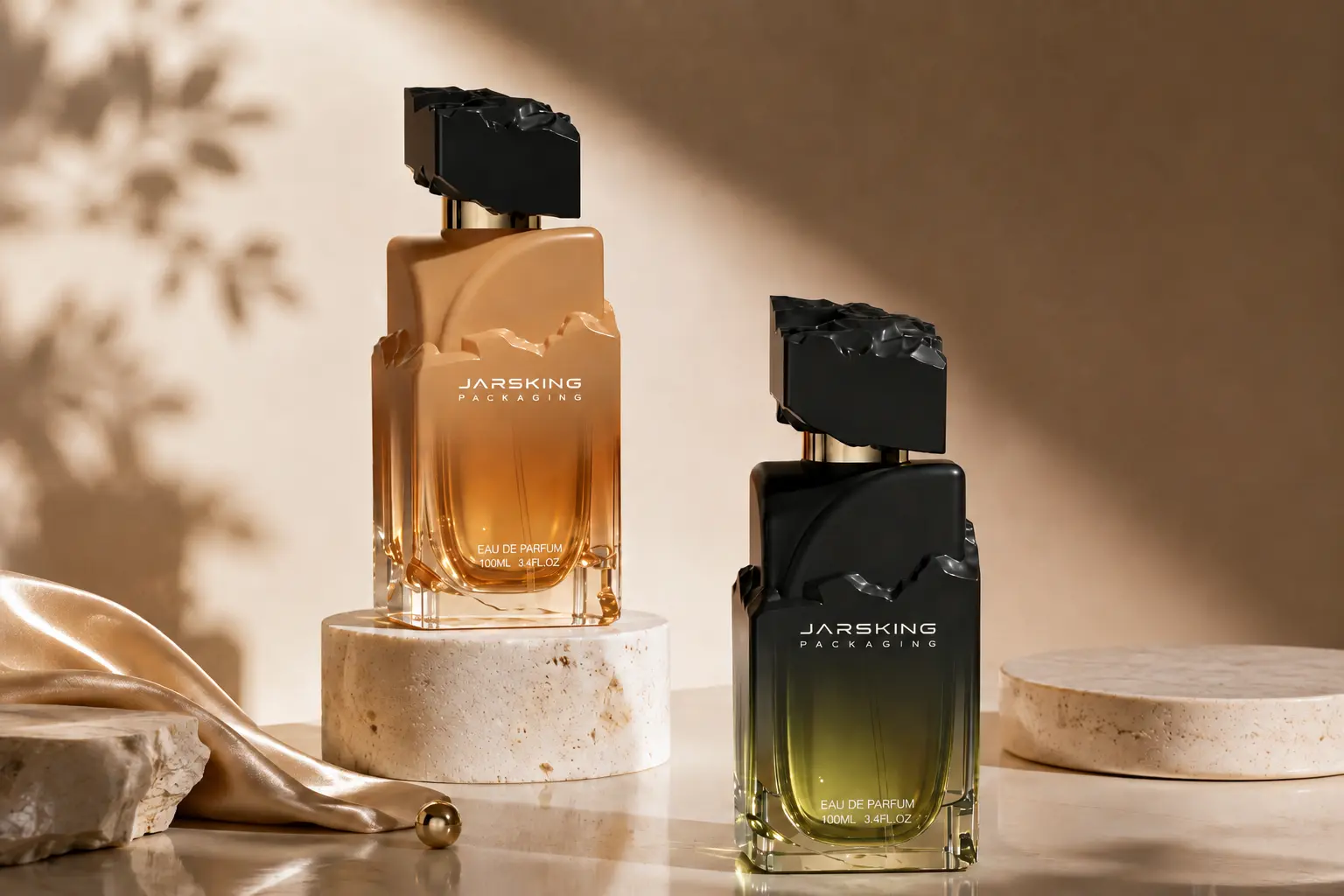

You approve a pre-production sample that looks breathtaking on your desk. The glass is crystal clear, the gold hot-stamping shines, and the pump action feels crisp and effortless. But three months after shipping to retail partners, an uncomfortable reality sets in. The fragrance inside has turned slightly hazy, the dip tube has warped into a deep curve, the foil on the collar is peeling, and cartons are arriving at boutiques with faint, oily rings around the bottom.
What went wrong? The bottle looked flawless on day one, but no one tested it against the chemical realities of the finished fragrance juice.
Perfume packaging compatibility testing is a systematic evaluation of how a finished fragrance formulation interacts with its complete packaging assembly over time. It exposes the bottle, pump, gasket, dip tube, collar, cap, label, and decorative finish to the actual formula under controlled conditions to catch material breakdown, container interaction issues, formula distortion, and product leakage before commercial production begins.
Verifying formulation compatibility is not just a technical checkbox; it is the single most reliable way to protect your brand investment and ensure your customers experience the fragrance exactly as intended.
1. What Is Perfume Packaging Compatibility Testing?
Perfume packaging compatibility testing evaluates whether a fragrance formula and its complete packaging system can coexist harmoniously across their intended shelf life. Instead of testing an empty bottle or isolated pump, this process examines how the chemical components of the liquid and the physical materials of the container influence one another when sealed together in real-world conditions.
The core purpose is simple: verify that the packaging keeps the perfume safe, stable, and contained, while ensuring that the perfume does not degrade, discolor, or compromise any part of the cosmetic packaging.
Definition and Core Purpose
When you bottle a fragrance, you are not simply storing scented water. You are housing a dynamic chemical solution—typically 70% to 90% high-proof denatured alcohol, carrier solvents, UV filters, fixatives, and complex aroma compounds.
Compatibility testing confirms that over months or years of storage, this solution will not cause plastic parts to swell, gaskets to dissolve, metals to corrode, or internal lacquers to peel. At the same time, it ensures the container does not leach unwanted compounds back into the perfume.
Stability Testing vs. Packaging Compatibility Testing
It is easy to mix up stability testing and compatibility testing, but they solve two different problems:
– Formula stability testing looks at the juice alone. You place your bulk formula inside neutral laboratory glass to see if the fragrance separates, oxidizes, or discolors under sunlight and heat.
– Packaging compatibility testing evaluates the mutual relationship between that formula and its specific packaging assembly. It asks whether the dip tube stretches in the alcohol, whether the gasket maintains its seal, and whether the printed logo survives an accidental drip of perfume.
Formula stability testing confirms the recipe works; compatibility testing confirms the bottle system can actually deliver it.
When Should a Perfume Brand Conduct Compatibility Testing?
Testing is necessary whenever a project variable changes that could alter the chemical or mechanical balance between the liquid and the container:
– When developing and approving a brand-new primary packaging system
– After tweaking the fragrance formulation, such as adjusting alcohol proof, carrier oils, or natural concentrations
– When changing a component supplier for pumps, rubber gaskets, dip tubes, or glass bottles
– After switching decorative techniques, such as moving from ceramic screen printing to UV-cured inks or hot stamping
– When introducing post-consumer recycled (PCR) glass, bio-based resins, or alternative plastics
– Before signing off on final tooling and approving bulk manufacturing runs
Conducting tests on anything less than production-representative components leaves blind spots that can resurface during mass distribution.
2. Why Compatibility Testing Matters for Perfume Brands
A packaging failure is never just an aesthetic nuisance. It creates immediate logistical friction, strains retail relationships, and undermines the trust you have built with your consumers.
Protecting Fragrance Integrity and Intended Shelf Life
Perfume formulations are delicate chemical structures. Natural essential oils and synthetic aroma molecules can easily break down when exposed to air, reactive metals, or unstable polymers.
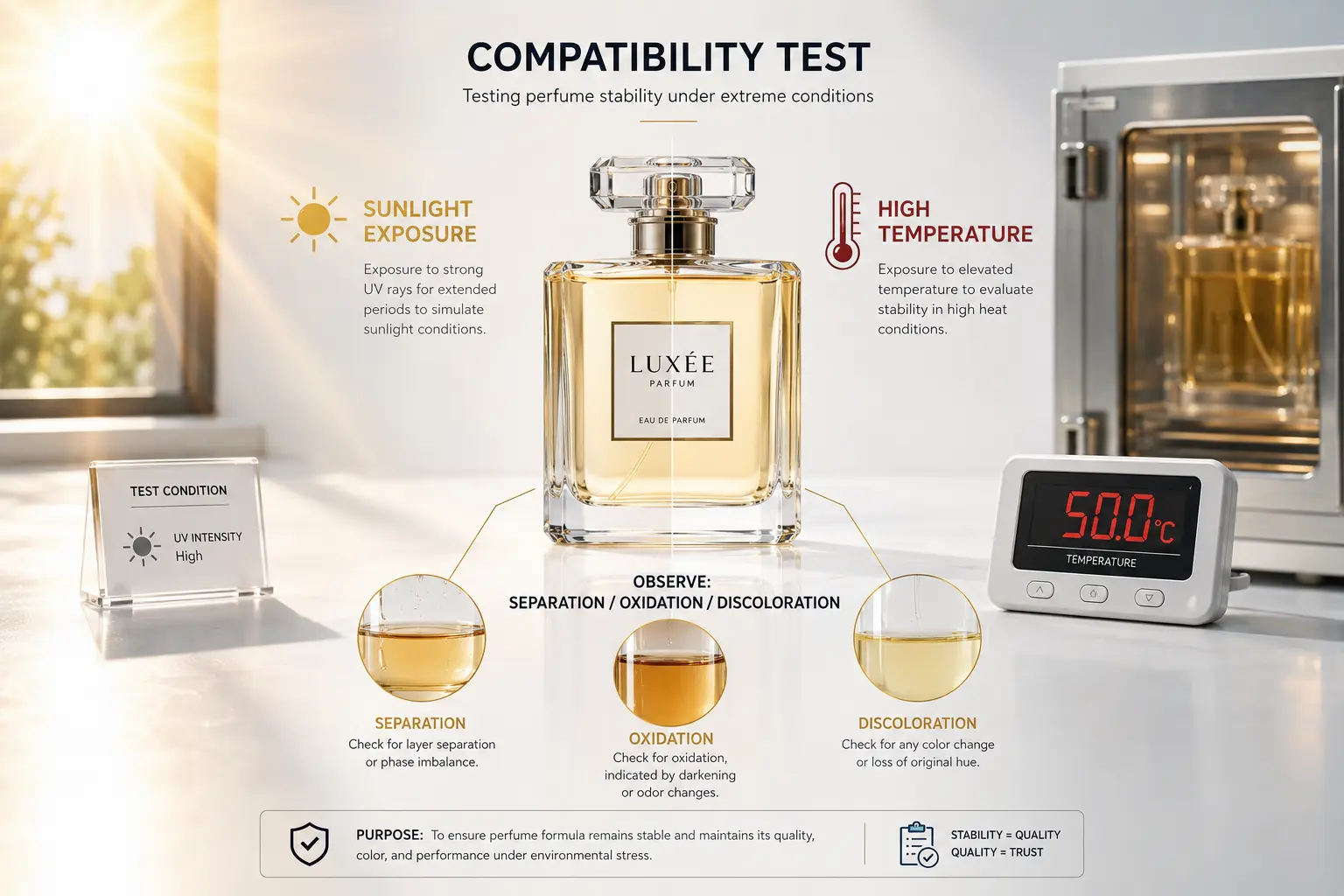
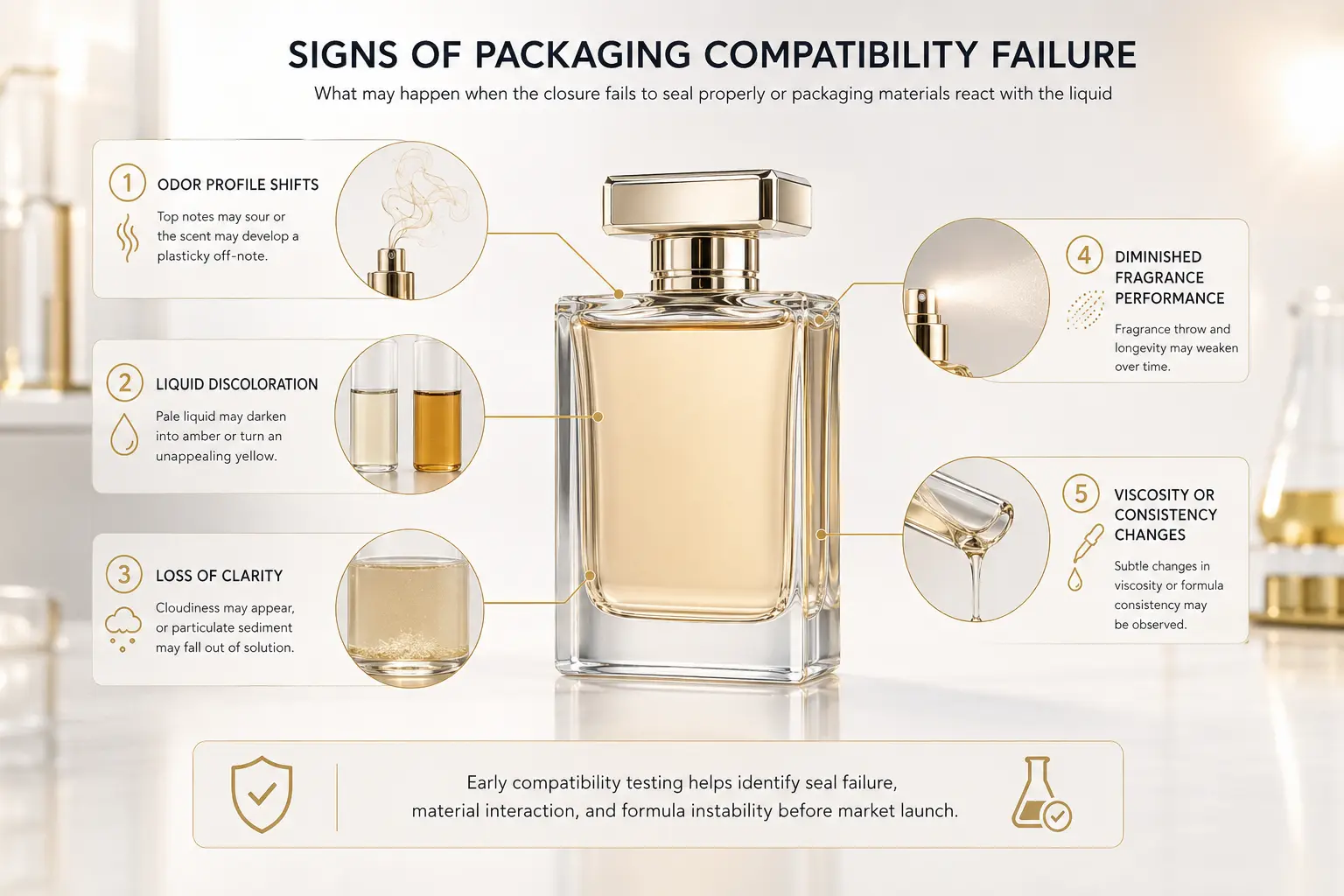
When a container closure fails to seal properly or packaging materials react with the liquid, you may notice:
– Odor profile shifts, where top notes sour or the scent develops a plasticky off-note
– Liquid discoloration, such as pale liquids darkening into amber or turning an unappealing yellow
– Loss of clarity, cloudiness, or particulate sediment falling out of solution
– Diminished fragrance throw and longevity
– Subtle changes in viscosity or formula consistency
Careful shelf life evaluation protects against early essential oil degradation, making sure the first spray smells just as balanced as a bottle opened two years later.
Preventing Chemical Reactions and Material Degradation
Because alcohol and fragrance oils act as potent organic solvents, they continuously test the chemical resistance of every material inside the bottle.
Without thorough pre-testing, unexpected chemical reactions can lead to:
– Plastic dip tubes absorbing solvents, expanding, and kinking against the bottle bottom
– Elastomer gaskets swelling, softening, or becoming brittle, losing their spring tension
– Internal metal springs in corroding or releasing metal ions into the juice
– Exterior lacquer coatings, silk-screened logos, and label adhesives softening, bubbling, or peeling after casual contact with overspray
Catching these signs of material degradation early prevents widespread component failure across entire production batches.
Reducing Leakage, Evaporation, and Weight Loss
Product loss rarely happens all at once. In many cases, product leakage is subtle—an invisible loss caused by micro-channeling along a poorly fitted gasket or slow evaporation through permeable plastics.
Over several months on a warm retail shelf, this gradual weight loss lowers the fill line, concentrates the remaining perfume oils, and creates an inconsistent visual presentation across store displays. Differentiating between visible leaks, vapor evaporation, and material permeability allows engineers to pinpoint the exact failure point and adjust gasket hardness, crimp depth, or thread torque accordingly.
Protecting Consumer Experience and Brand Reputation
When a customer purchases a luxury fragrance, the tactile experience matters just as much as the scent. If the pump sticks halfway down, the collar wobbles, or the bottle leaves oily rings on a dresser, the product feels cheapened.
The commercial consequences of unverified packaging are immediate:
– Spike in customer service complaints and refund requests
– Damaged retail cartons and stained secondary packaging
– Costly product returns, batch rework, and delayed seasonal launches
– Unplanned product recalls that erode trust with buyers and distributors
3. Which Perfume Packaging Components Should Be Tested?
A finished perfume bottle is an assembly of distinct materials operating together under mechanical tension and chemical exposure. Each component requires targeted inspection during testing.
Direct Contact vs. Indirect Contact Components
To evaluate risks clearly, packaging engineers divide the assembly into direct contact parts and indirect contact finishes:
– Direct Contact Components: These parts touch the fragrance continuously. They include the glass bottle interior, the low-density polyethylene dip tube, the elastomer sealing gasket, the internal pump piston, and the internal stainless steel spring and check ball.
– Indirect Contact Finishes: These parts experience vapor exposure, filling overspray, or handling contact. They include outer over-caps and liners, anodized aluminum collars, silkscreen graphics, metallic hot-stamping, label adhesives, and exterior lacquer coatings.
Glass Bottles and Internal Contact Surfaces
Type III flint glass is the industry standard for perfume spray bottles due to its chemical inertness, high clarity, and non-porous surface. However, the complete glass system still demands evaluation.
Technicians examine the inner neck finish for surface smoothness and dimensional uniformity, verify that internal glass treatments do not cause sediment dropout, and check that tinted or coated glass retains its color stability without fading or peeling when in contact with the juice.
Spray Pumps, Gaskets, Dip Tubes, and Sealing Components
These mechanical parts carry the highest risk profile in any fragrance packaging assembly. Because they contain multiple polymers, elastomers, and metal alloys, they are especially prone to swelling, mechanical binding, and chemical leaching.
Testing validates that dip tubes maintain their cut length and flexibility, rubber or polyethylene gaskets retain their elasticity without hardening, and internal pump chambers prime smoothly and return consistently with every press.
Caps, Collars, Labels, Adhesives, and Decorative Finishes
Even components that sit outside the bottle frequently come into indirect contact with fragrance through filling line overspray, atomized mist, handling, and condensation.
Testing must evaluate:
– Coating adhesion on exterior lacquered glass
– Solvent resistance of silkscreen inks and metallic hot-stamping
– Resistance of [perfume caps and collars](https://jarskingglobal.com/perfume-caps/) to stress cracking or tarnishing
– Label film stability and adhesive resistance against lifting or edge-bubbling
Plastic, Recycled, and Alternative Cosmetic Packaging Materials
For brands exploring plastic flacons, perfume sample vials, or post-consumer recycled (PCR) materials, additional vigilance is required.
Polyethylene (PE), polypropylene (PP), and polyethylene terephthalate (PET) have variable barrier properties compared to glass. Thorough barrier function testing ensures these materials do not absorb volatile top notes, allow excessive oxygen penetration, or exhibit batch-to-batch structural inconsistencies.
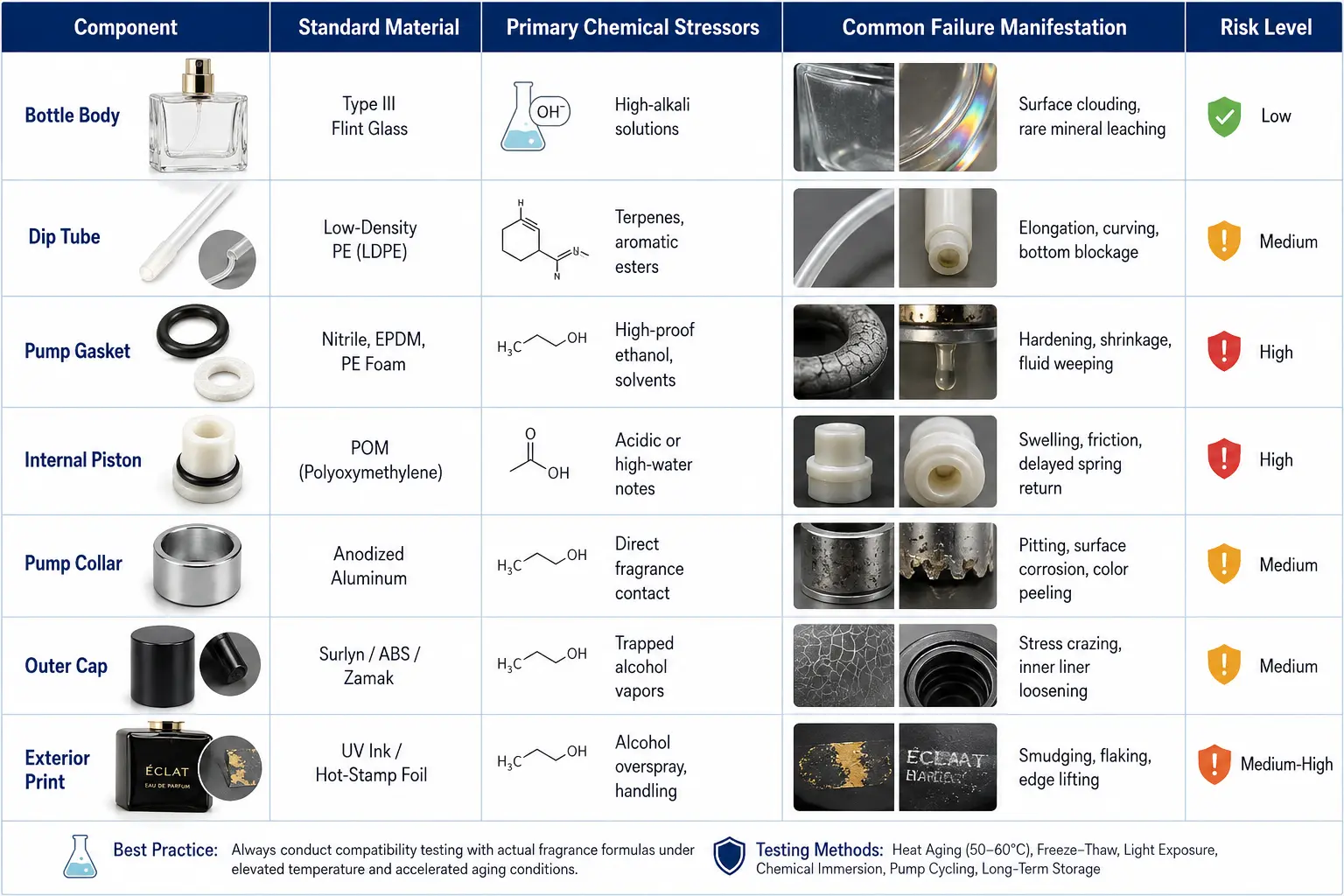
4. Technical Comparison: Packaging Material Risks & Common Failure Points
Selecting the right raw materials during custom perfume packaging development helps brands avoid common compatibility pitfalls from the start:
5. How to Build a Perfume Packaging Compatibility Testing Protocol
A well-structured testing program simulates real-world storage conditions while tracking measurable physical and chemical data points.
Use the Final Formula and Complete Packaging System
Never perform compatibility testing with a substitute liquid like plain water or pure alcohol. Water lacks the solvency and surface tension of compounded fragrance oils, while pure ethanol misses the specific chemical reactions caused by natural essential oils and fixatives.
The test configuration must use:
– The final, macerated and filtered fragrance juice
– The exact production-intent glass bottle with target neck finish
– The selected spray pump engine, dosage chamber, and spring
– The specific sealing gasket material and thickness
– The production dip tube cut to exact length
– Fully decorated bottles featuring intended lacquers, inks, and hot-stamping
– Representative caps, collars, and primary labels
Establish Control Samples and Baseline Measurements
Before placing any bottle into an environmental chamber, record its initial baseline parameters:
– Precise total filled weight on an analytical scale (accurate to 0.0001g)
– Visual liquid color and optical clarity
– Baseline olfactory profile evaluated by a trained nose
– Initial pump priming strokes and spray output dosage (mg/stroke)
– Spray pattern uniformity and droplet dispersion
– Initial closure torque or crimp diameter and depth dimensions
– Photographic records of all decorative finishes and labels
Store an identical set of filled control bottles in an unaged, dark environment at 4°C to 5°C. This control group serves as your sensory and chemical benchmark throughout the evaluation.
Determine Sample Quantities and Test Conditions
Sample counts and test durations should reflect the scale, budget, and risk profile of your project rather than an arbitrary number. A practical protocol distributes filled units across multiple storage conditions:
– Cold Control (4°C – 5°C): Acts as the unaged visual and olfactory reference for baseline checks.
– Ambient Room Temperature (20°C – 25°C): Tracks typical shelf conditions over 6, 12, or 24 months.
– Elevated Heat Chamber (40°C – 45°C): Accelerates chemical reaction rates, vapor pressure, and weight loss checks.
– Thermal Cycling (-10°C to 40°C): Cycles samples every 24 to 48 hours to evaluate mechanical seal response to thermal shock, expansion, and contraction.
– Orientation Split: Store 50% of samples upright and 50% inverted or horizontal. Inverted storage ensures constant liquid contact with pump gaskets, crimp seams, and collar undercuts.
Define Acceptance Criteria Before Testing
Establishing clear pass/fail thresholds before testing begins prevents subjective debates when reading results:
– Weight loss threshold: Total weight loss at 40°C across 12 weeks should typically remain below 1.0% to 1.5%.
– Containment integrity: Zero visible fluid leakage, weeping, or crystallization around the neck.
– Mechanical performance: Consistent pump priming within 3 to 5 strokes; spray dosage remains within ±10% of specification.
– Sensory fidelity: No unacceptable deviation in top, heart, or base notes compared to the cold control.
– Visual standards: No sediment, cloudiness, lacquer peeling, or label delamination.
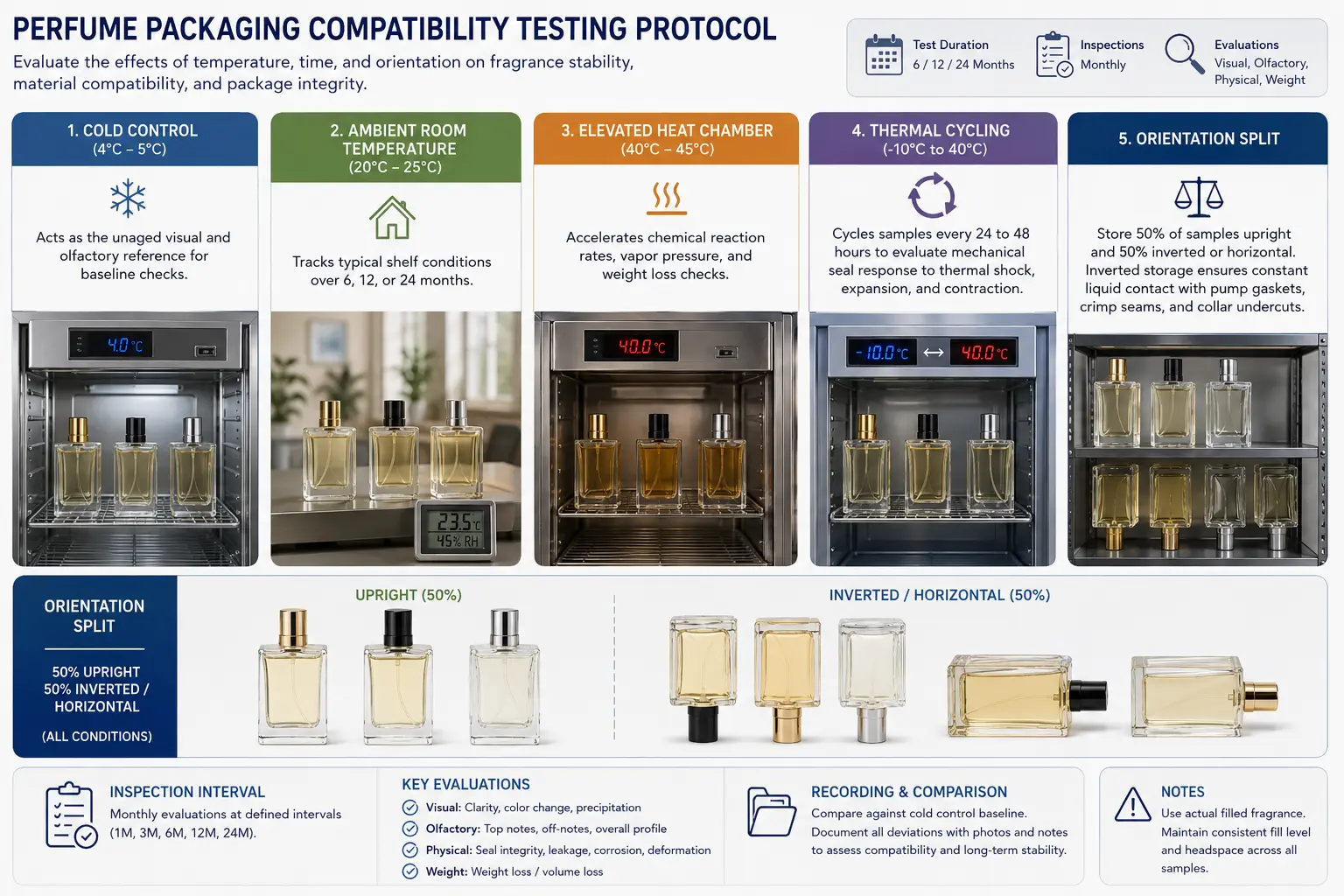
6. Essential Perfume Packaging Compatibility Test Methods
Evaluating a complete package requires a mix of environmental, mechanical, and analytical testing methods.
Accelerated Stability Test
An accelerated stability test exposes filled packaging to sustained elevated temperatures (typically 40°C to 45°C) to speed up chemical and physical interactions. While accelerated testing provides an indispensable risk-screening tool, it represents a simulation model; it should always be paired with real-time room-temperature tracking for definitive long-term validation.
Weight Loss Test and Seal Integrity Evaluation
A structured weight loss test confirms that your closure creates an airtight barrier:
– Tare and record the initial filled weight of each bottle at Day 0 on a calibrated analytical scale.
– Place bottles into designated ambient and elevated temperature chambers according to the protocol.
– Remove samples at Weeks 2, 4, 8, and 12, allowing them to stabilize to room temperature before reweighing.
– Inspect the neck finish, gasket area, and pump housing for micro-beading, salt rings, or sticky residue.
– Calculate the percentage weight change against the Day 0 baseline and compare with acceptance limits.
Consistent weight loss without visible pooling indicates slow vapor evaporation through the gasket or actuator orifice.
Leakage, Inversion, and Transportation Simulation Tests
Packages undergo significant physical stress during distribution. Inversion testing checks whether bottles held upside down or horizontally leak under atmospheric pressure.
Combining this with vacuum chamber testing (simulating airfreight cargo hold depressurization) and transit vibration tables verifies that the crimp or screw seal holds up during overseas shipping.
Barrier Function Testing
Barrier testing evaluates how well a packaging material prevents the escape of volatile aroma chemicals and the ingress of atmospheric oxygen or moisture. While glass provides an absolute barrier, plastic flacons and multi-material refill pouches require rigorous barrier validation to prevent scent fading and formula oxidation.
Extractables and Leachables Testing
This analytical protocol assesses chemical migration between contact materials and the perfume juice:
– Extractables are chemical compounds that can be pulled from packaging materials when exposed to harsh laboratory extraction solvents.
– Leachables are the specific chemical substances that naturally migrate from plastics, elastomers, or coatings directly into the perfume under normal storage conditions.
Using Gas Chromatography-Mass Spectrometry (GC-MS), analytical chemists ensure no vulcanizing agents, plasticizers, or unreacted monomers contaminate the formulation.
Environmental Stress Cracking and Mechanical Integrity Testing
Polymers subjected to internal mechanical stress—such as plastic collars snapped over glass beads or pump actuators pressed onto stems—are vulnerable to environmental stress cracking when exposed to alcohol vapors. Testing monitors components under tension to verify they do not develop micro-fractures, split, or deform.
Spray Pump Performance and Cycle Testing
A pump must dispense reliably from the first spray to the final drop. Testing protocols evaluate:
– Number of actuations required to achieve prime
– Average spray output volume per stroke
– Plume geometry, mist angle, and droplet distribution
– Piston recovery time during rapid actuations
– Seal tightness around the actuator stem after 50, 100, and 300 cycles
Alcohol, Adhesion, and Abrasion Testing for Decoration
Outer decorations inevitably come into contact with fragrance drips during regular use. Standard tests include:
– Alcohol Rub Test: Rubbing printed, stamped, or coated surfaces with a 70% to 90% ethanol-soaked cloth under standardized pressure to check for ink transfer or softening.
– Cross-Hatch Tape Adhesion: Scoring a lattice pattern into exterior coatings, applying pressure-sensitive tape, and snapping it off to confirm the lacquer adheres firmly to the glass.
– Immersion Test: Submerging decorated components directly in fragrance solution for 24 to 48 hours to check for edge-lifting, clouding, or flaking.
7. What Should Be Monitored During Compatibility Testing?
During scheduled inspections at Weeks 2, 4, 8, and 12, technicians document observations across four distinct categories:
Changes in the Fragrance Formula
– Olfactory drift: Comparing the warm sample directly against the 4°C control to detect souring, flattened top notes, or plasticky off-odors
– Color shifts: Documenting any darkening, browning, yellowing, or bleaching
– Optical clarity: Checking for haze, cloudiness, or oil-water phase separation
– Particulate matter: Inspecting the bottom of the bottle for floating debris or chemical precipitates
Changes in the Packaging Components
– Dip tube condition: Measuring for length elongation, swelling, curving, or loose stem fit
– Gasket condition: Checking for hardening, shrinkage, stickiness, or loss of resilience
– Plastic integrity: Inspecting pump housings, collars, and actuators for softening, warping, or stress fractures
– Metal finishes: Checking for pitting, oxidation, rust on internal springs, or collar tarnishing
Changes in Packaging Function
– Evaporation and leakage: Tracking analytical weight loss and inspecting for residue around the neck
– Actuation mechanics: Checking for sticky pistons, delayed return, or pump seizure
– Spray pattern: Monitoring for changes in mist dispersion, spitting, or irregular jetting
– Cap fit: Verifying over-caps maintain clean click-fit or magnetic closure retention
Aesthetic and Decoration Changes
– Surface finishes: Checking for softening, blistering, or dulling of high-gloss lacquers
– Silk-screen graphics: Verifying sharp text edges without bleeding or smudging
– Hot-stamping foils: Checking for pinholing, flaking, or metallic tarnishing
– Labels and adhesives: Inspecting for edge-lifting, adhesive oozing, or oil staining across paper facestocks
8. How to Interpret Compatibility Testing Results
Interpreting laboratory and visual findings correctly helps your team determine whether an issue warrants a simple adjustment or a complete packaging redesign.
Critical, Functional, and Cosmetic Failures
Categorizing issues by severity clarifies the necessary corrective action:
– Critical Failures: Issues that compromise safety, fail regulatory compliance, or cause total product loss. Examples include severe chemical leaching, heavy leakage, cracked bottle necks, or total formula discoloration.
– Functional Failures: Issues that impair everyday use without causing safety hazards. Examples include pump seizure, excessive weight loss, dip tube kinking, or loose cap fit.
– Cosmetic Failures: Minor visual imperfections that affect aesthetic presentation, such as slight label edge-lifting, minor hot-stamping wear, or subtle collar color shifts.
How to Identify the Source of a Failed Test
When a failure occurs, isolating single variables helps pinpoint the root cause:
| Observed Failure Symptom | Variable to Isolate | Recommended Diagnostic Test |
|---|---|---|
| Pump sticks down or fails to re-prime | Internal piston swelling vs. formula viscosity | Test identical pump engine in pure neutral alcohol to evaluate POM swelling |
| Micro-leakage or fluid weeping at neck | Gasket elastomer compatibility and thickness | Compare PE foam, EPDM, and solid silicone gaskets on identical bottle finish |
| Exterior coating or silkscreen peels | Glass surface pre-treatment vs. ink formulation | Compare flame-treated or silane-primed glass against untreated sample bottles |
| Dip tube kinks or bends sideways | Solvent absorption and plastic elongation | Measure dip tube length change in formula vs. pure ethanol control |
When Should a Component Be Replaced or Retested?
Any significant change in raw material chemistry, supplier sourcing, or manufacturing tooling resets the compatibility clock. You should retest if:
– The fragrance house adjusts carrier solvents, fixatives, or essential oil concentrations
– The pump supplier updates resin grades for dip tubes or internal valves
– The glass manufacturer modifies neck finish tooling dimensions
– The decorator switches ink brands, curing ovens, or lacquer chemistries
Why Accelerated Testing Does Not Fully Replace Real-Time Evaluation
While accelerated thermal testing provides rapid risk assessment, high heat can occasionally trigger artificial chemical reactions that would never happen at room temperature.
Conversely, subtle long-term migration phenomena might take six to nine months of ambient storage to show up. Use accelerated testing for pre-production sign-off, but keep ambient real-time stability samples running in the background for long-term confirmation.
9. Plan Compatibility Testing Before Approving Your Perfume Packaging
A successful fragrance launch relies on far more than beautiful exterior design; it requires total harmony between the chemistry of your juice and the engineering of your container.
At jarskingglobal, we believe great packaging should eliminate risk, not create it. Our technical team works alongside brand founders, product developers, and procurement managers to ensure that every custom glass bottle, fine-mist pump atomizer, sealing gasket, and decorative collar is engineered for long-term compatibility.
By taking the time to test your complete, production-ready assembly with your final fragrance formula, you protect your product’s scent profile, prevent costly supply chain recalls, and deliver a reliable luxury experience from the very first spray.