
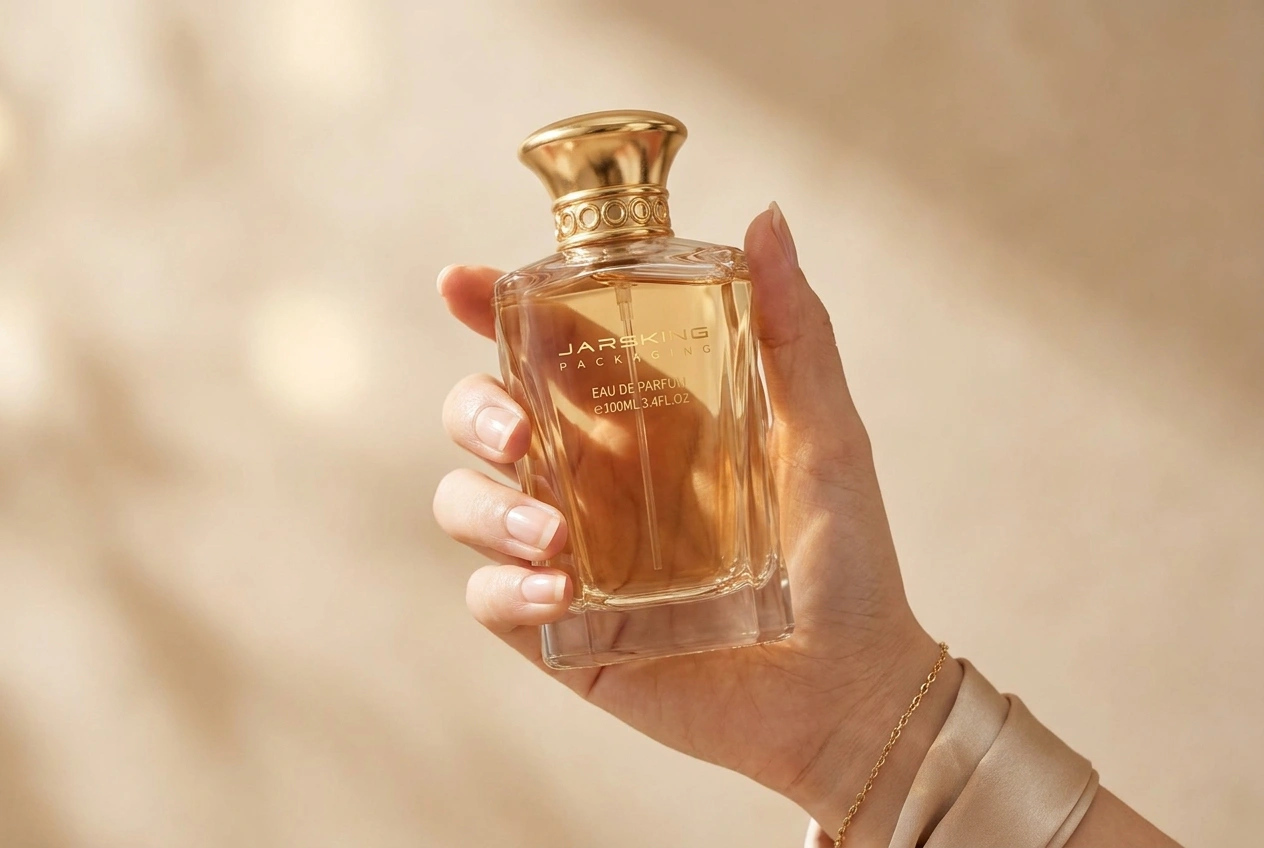


Perfume bottles are delicate mechanical assemblies. When you look at a finished fragrance, it seems like a simple glass bottle with a shiny sprayer on top. Behind the scenes, that package relies on a razor-thin balance between molded glass tolerances, flexible internal gaskets, crimped metal collars, and tiny internal pump valves. Because fine fragrance uses high-proof ethanol, it is thin, volatile, and quick to build internal pressure whenever temperatures rise or ambient pressure drops. If there is even a microscopic gap between the bottle neck and the pump mechanism, liquid will slowly weep out and valuable scent will silently evaporate.
Perfume bottle leakage testing is the quality control process that checks whether your assembled bottle, pump, gasket, and cap can maintain an airtight seal under real-world shipping and storage conditions. By running bottles through methods like vacuum decay, pressure drop, water bubble immersion, and dye penetration, teams can spot seal defects on the production floor before finished boxes ever leave the warehouse.
Getting a clear handle on these testing methods, machine setups, and mechanical failure points helps you protect your formula, keep cartons spotless, and avoid painful batch recalls down the road.
1. Understanding Perfume Bottle Leakage and Its Importance
A leaky perfume bottle is rarely just a “bad piece of glass.” In our day-to-day work with fragrance components, we almost always find that leaks happen where different materials meet: glass, plastic dip tubes, elastomer gaskets, and metal ferrules.
| Component Interface | What It Does | Where Things Usually Go Wrong |
| Glass Bottle Neck Finish | Creates the flat landing surface where the gasket and pump seat | Uneven mouth surface, oval openings, or rough mold parting lines |
| Sealing Gasket (PE / EVA / Silicone) | Squishes flat between the glass lip and pump to block air and liquid | Loses bounce-back, shrinks over time, or gets pinched unevenly |
| Pump Mechanism & Ferrule | Delivers a fine mist and locks the assembly onto the bottle neck | Crimp jaws set too loose, stripped plastic threads, or cracked internal chambers |
| Collar & Actuator Cap | Directs the spray and finishes the outer look of the bottle | Crooked fit, loose friction grip, or inner metal rubbing the glass neck |
Common Causes of Perfume Bottle Leaks
When a bottle weeps or loses liquid in transit, the root cause usually comes down to three mechanical headaches:
Uneven Neck Finishes on the Glass: Glass bottles are formed in hot molds, and as the glass cools, the neck opening can turn slightly oval or develop a wavy top rim. If that top sealing surface dips by even 0.10 mm to 0.15 mm, the gasket cannot press down evenly, leaving a hairline gap where alcohol vapor slips through.
Mismatched Crimp Dimensions or Inconsistent Screw Torque: For standard crimp necks like the FEA 15, everything depends on the crimping tool. If the crimp height is a fraction too tall or wide, the gasket stays loose. If the machine presses too hard, it cuts right through the gasket. For screw-neck bottles, capping heads with too little torque allow vibration to shake caps loose, while too much torque cracks the inner plastic threads.
Gaskets That Lose Their Grip Over Time: A gasket has to stay flexible for months or years. If the material is too stiff, it cannot mold itself into the microscopic texture of the glass rim. If the gasket material reacts poorly with your specific fragrance oil, it can soften, swell, or shrink, ruining the initial airtight fit.
Why Leak-Proof Packaging is Essential for Quality Assurance
Unlike thicker lotions or water-based cosmetics, alcohol-heavy perfumes are tricky to contain. When a package is not completely airtight, several messy problems follow:
Top Notes Evaporate and Scents Shift: Alcohol and delicate top notes (like citrus or green florals) are the first things to slip out of a micro-leak. Air also sneaks in, which oxidizes sensitive natural oils, shifts the fragrance profile, and can darken the liquid color before your customer even sprays it.
Alcohol Strips Shiny Collars and Exterior Paint: Perfume alcohol is a strong solvent. When small droplets weep past the neck, capillary action pulls them right under the shiny metal collar or painted bottle shoulder. Within days, that alcohol softens the glue, bubbles the UV lacquer, and makes expensive electroplated finishes peel right off.
Stained Cartons and Rejected Retail Shipments: A single leaking bottle inside a master carton can soak through tissue wraps, ruin outer gift boxes, and smudge warehouse barcode labels. That usually leads to messy retail chargebacks or entire pallets being turned away at distribution hubs.
2. Standard Perfume Bottle Leakage Testing Methods
Quality teams use four core testing methods to catch liquid leaks and invisible vapor paths. The right pick depends on whether you want a quick, clean test during live production or an in-depth destructive test to diagnose why a sample failed.
| Test Category | Main Methods | Key Takeaways |
| Non-Destructive Testing | Vacuum Decay, Pressure Drop, Helium Leak Detection | Keeps finished product clean and usable, leaves no water or dye marks, great for high-value stock |
| Destructive Testing | Water Bubble Submersion, Methylene Blue Dye Ingress | Shows you visually where bubbles or dye sneak through, but requires drying or discarding the bottle |
Vacuum Decay Testing
Vacuum decay is a clean, non-destructive method standardized under ASTM F2338. It has become a favorite across luxury fragrance brands because it is fast, highly accurate, and does not ruin the bottle.
Here is how it works on the bench: you place a filled, assembled perfume bottle inside an airtight chamber tailored to the bottle’s shape. The machine’s vacuum pump pulls the chamber down to a target negative pressure (typically between -50 kPa and -80 kPa) and then shuts off the connection. Highly sensitive electronic pressure sensors monitor the chamber over a few seconds. If the crimp or gasket is loose, expanding air and alcohol vapor from inside the bottle leak out into the vacuum chamber, causing the pressure to rise.
The biggest upside is simple: because the outside of the bottle stays completely dry and clean, passing bottles can go straight back into the packaging line and into customer boxes. You get reliable quality data without burning through inventory.
Submersion Water Bubble Test
The water bubble test, based on ASTM D3078, is the classic hands-on test you will see on most factory floors.
An operator places the capped, filled bottle into a clear acrylic tank filled with clean water. The lid seals, and a vacuum pump pulls air out of the space above the water line (usually around -30 kPa to -70 kPa). As the air pressure drops, the air trapped inside the bottle expands. If there is a leak around the crimp ferrule, glass neck, or spray button, a steady stream of bubbles floats up through the water.
This method gives you an instant, visual answer to where a leak is happening. The trade-off is that the bottle gets wet. Metal collars can develop water marks, and water can sneak into the spray button orifice during venting, so tested bottles generally have to be blown dry or set aside.
Pressure Drop Leak Detection
The pressure drop method is built for testing empty glass flacons and bare component assemblies before any fragrance liquid is filled.
A testing fixture clamps an airtight rubber nozzle directly onto the bottle neck finish. The machine pumps clean, dry compressed air into the empty bottle until it reaches a set positive pressure (often +100 kPa to +300 kPa) and then cuts the air line. Electronic sensors watch the internal pressure over a few seconds. If there are hairline cracks in the glass, thin spots around the shoulder, or rough mold seams on the sealing lip, air bleeds out and the pressure gauge drops.
Because this test only takes 2 to 5 seconds per bottle, it is ideal for high-speed automated sorting on the glass factory line before bottles move to screen printing, hot stamping, or packing.
Methylene Blue Dye Penetration Test
The dye penetration test is an aggressive laboratory check designed to catch microscopic capillary paths that bubble tests might miss.
Assembled bottles are submerged in a tank of water mixed with bright blue methylene dye inside a vacuum chamber. The machine pulls a vacuum of -50 kPa to -70 kPa, holds it for 15 to 30 minutes to pull air out of tiny gaps, and then releases the vacuum back to normal room pressure. That sudden pressure change forces the blue dye solution into any micro-channels between the glass rim and the pump gasket.
Technicians pull the bottles out, wash and dry the outside thoroughly, and carefully pry off the pump collar. Under a magnifying lamp or microscope, they inspect the inner neck rim. Any trace of blue dye that made it past the gasket’s outer edge is clear physical proof that the seal failed.
Comparison of Leak Testing Methods
| Method | Test Style | Sensitivity Level | Best Used For | Can You Keep the Sample? |
| Vacuum Decay | Non-destructive | High (catches tiny vapor leaks down to a few microns) | Finished luxury perfumes, cleanroom quality checks | Yes, fully reusable |
| Water Bubble Submersion | Destructive | Moderate (visual check for streaming bubbles) | Daily batch checks, quick troubleshooting on the line | Needs drying or repacking |
| Pressure Drop | Non-destructive | Moderate to High (measures internal air loss) | Pre-screening empty glass bottles and molds | Yes, fully reusable |
| Dye Penetration | Destructive | Very High (reveals exact capillary stain paths) | Validating new gaskets and setting up crimping tools | No, sample is dismantled |
| Helium Leak Detection | Non-destructive | Ultra-High (molecular gas tracking) | R&D validation and pump engineering studies | Yes, fully reusable |
3. Working Principle of Perfume Bottle Leak Testers
No matter which specific testing machine you use, the underlying physics is straightforward: liquids and gases always travel from high-pressure zones to low-pressure zones whenever there is a mechanical opening.
| Testing Stage | What the Machine Does | What Happens Inside the Bottle |
| Evacuation | Vacuum pump draws air out of the test chamber around the bottle | Creates a sharp pressure drop outside the bottle |
| Stabilization | Valves close; chamber pressure settles for a few seconds | Air turbulence calms down so sensors can read accurately |
| Measurement | Digital sensors watch for tiny pressure changes in the chamber | Internal expanding air pushes vapor out through any weak seal |
| Pass / Fail Verdict | Microprocessor compares the decay rate to pre-set limits | Automatically flags bad bottles and logs the result |
How Air Impermeability Testing Works
Air impermeability simply measures how well your bottle closure keeps outside air out and inside fragrance in under different stresses.
Fitting the Chamber: Quality machines use chamber inserts molded closely to your specific bottle shape (round, square, or custom flacons). Cutting down excess empty air space inside the chamber makes the pressure sensors far more sensitive to tiny leaks.
Pulling the Vacuum: The machine pulls air until the chamber hits your exact target pressure (such as -60 kPa).
Watching the Pressure Gradient: As the outside pressure drops, the air-alcohol mix inside the bottle pushes outward against the gasket, crimp joint, and inner pump valves.
Reading the Data: High-precision digital transducers measure tiny pressure changes down to small fractions of a Pascal. If the chamber pressure rises faster than your baseline limit, the machine flags the bottle as a failure.
Simulating Pressure and Temperature Variations
During air travel, airplane cargo holds experience air pressure drops equal to being 1,800 to 2,400 meters high (roughly -20 kPa to -35 kPa compared to ground level). On the ground, shipping containers sitting in the summer sun can easily climb to 45°C or 50°C.
When liquid fragrance gets hot, it expands, shrinking the air space inside the bottle and driving up internal pressure just as the plane climbs into thin air. Professional test protocols replicate this real-world stress by warming bottles in an oven at 45°C for 24 hours and moving them directly into a vacuum decay chamber. This verifies that your bottles will not start weeping halfway across the Atlantic.
4. Key Features of Perfume Bottle Leakage Testing Equipment
When you are looking at testing equipment for your QC lab or assembly workshop, several key hardware details make the difference between reliable data and constant headaches.
| Equipment Feature | What to Look For | Why It Matters on the Floor |
| Pneumatic Pressure Control | Dual-stage digital valves with ±0.5% pressure stability | Stops sudden vacuum jolts that pop off loose caps prematurely |
| Digital Controller & Logging | Programmable test cycles with USB/data export | Eliminates operator guesswork and keeps clean audit trails |
| Chamber Design | Quick-swap acrylic and stainless steel fixtures | Lets you switch between sample vials and 100 ml bottles easily |
| Differential Sensors | High-resolution micro-transducers | Catches tiny micro-leaks that human eyes will completely miss |
High-Precision Pressure and Vacuum Control
Basic testing tanks often use cheap manual turn-knobs, which can cause sudden vacuum spikes. Industrial testers use digital valves that ramp vacuum levels down smoothly. That controlled pull ensures you are testing the actual seal integrity rather than violently pulling the sprayer off the neck.
Automated Digital Testing and Data Logging
Relying solely on an operator’s eyesight means results can vary from shift to shift. Digital testers let you lock in test times, target pressures, and pass/fail thresholds under password protection. The machine tracks the pressure curve in real time, saves date-stamped test logs, and lets you export clear records to resolve quality questions with suppliers or retail partners.
Versatile Compatibility Across Bottle Materials
A perfume brand rarely sells just one bottle format. Your lineup might include 100 ml heavy-bottom flacons, 10 ml travel sprays, and tiny 2 ml sample vials. Modern testing benches feature quick-release connections and modular acrylic tanks, so your QC team can switch from testing a standard flacon to testing a mini vial in under two minutes.
5. Comprehensive Quality Control for Perfume Packaging
Catching leaks is not just an end-of-line checkpoint. True seal security is built step-by-step across component dimensions, assembly settings, and physical durability tests.
| Quality Stage | What Gets Inspected | Tools and Methods Used |
| Dimensional Checks | Neck mouth flatness, inner/outer diameter, lip planarity | Optical comparators, plug gauges, vernier calipers |
| Closure Verification | Crimp height and diameter, screw application torque | Digital crimp gauges, calibrated torque meters |
| Seal Testing | Airtight seal performance under negative pressure | Vacuum decay chambers, methylene blue dye baths |
| Physical Durability | Resistance to drops, bumps, and freight vibrations | Controlled drop testers, neck axis deviation gauges |
Bottle Cap Torque and Seal Integrity Testing
For threaded atomizers and refillable perfume bottles, getting the capping torque right is the single biggest factor in stopping leaks.
Application Torque: The rotational force your capping machine uses to screw the pump down and press the gasket flat against the glass rim.
Removal Torque: The force a customer needs to twist the cap off.
If application torque is too loose, normal transit vibrations will cause the cap to back off, loosening the gasket and letting liquid seep out. If the torque is too heavy, the glass threads can chip, the inner plastic collar can snap, or the rubber gasket can bunch up sideways. Packaging teams use digital torque meters to dial in an approved torque window (such as 0.8 N·m to 1.2 N·m for an 18 mm screw finish) and check samples from the line every hour.
Drop Resistance and Axis Deviation Testing
A bottle that stays dry on a quiet laboratory shelf also needs to survive real-world bumps, drops, and handling.
Drop Resistance Testing: Filled, crimped bottles are dropped onto a flat steel plate from 1.0 to 1.2 meters across several angles: flat on the base, on the shoulder, and upside down on the cap. Right after the drop, the bottles go straight into a vacuum chamber to make sure the jolt did not loosen the crimp or create hairline glass fractures.
Axis Deviation and Verticality Testing: If a bottle’s neck is tilted slightly off-center (axis deviation), automated crimping machines will push down unevenly. The crimp collet bites down hard on the high side of the rim while leaving the low side loose, creating an immediate leak point.
| Common Defect | Why It Happens in Production | What It Does to Your Seal |
| Tilted Neck (Axis Deviation) | Uneven glass cooling inside the blow mold | Crimp collar tilts, pinching one side of the gasket while leaving a gap on the other |
| Wavy Sealing Lip | Mold wear on the neck finish ring | Gasket cannot sit completely flat; creates tiny capillary leak paths |
| Over-Crimped Collar | Too much downward pressure on the crimp tool | Cuts into the gasket, warps the aluminum collar, and can chip the glass rim |
| Under-Crimped Collar | Worn crimp jaws or short machine stroke | Gasket stays loose and fails vacuum tests under mild pressure |
Best Practices for Leak Prevention in Production
Lock Down Neck Finish Drawings Early: Make sure your technical drawings clearly specify international neck standards (like FEA 15 crimp neck) with tight tolerances for rim flatness (within 0.1 mm) and sealing land width.
Run Formula Compatibility Tests in Advance: Before greenlighting mass production, make sure your specific perfume oil and alcohol blend does not soften, swell, or shrink your chosen gasket material. For a step-by-step walkthrough of chemical testing, take a look at our detailed guide on
Check Crimping Jaws Daily: Crimping jaws slowly wear down over thousands of cycles. Have your line technicians measure crimp diameter and crimp height with calipers at the start of every shift (for example, keeping FEA 15 crimp diameter at 14.85 mm ± 0.05 mm).
Set Up Clear AQL Vacuum Sampling: Establish clear Acceptable Quality Limit standards (such as AQL 0.65 for critical seal defects) for incoming packaging shipments, pulling random batch samples for routine vacuum chamber checks.
At jarskingglobal, we look at fragrance packaging as an interconnected system rather than separate parts. Because we manufacture custom glass bottles, precision fine-mist atomizers, and matching caps under one roof, our engineering team makes sure neck planarity, gasket hardness, and crimp dimensions align before we start mass production.
Whether you are launching a custom heavy-flint luxury flacon or building an automated refillable screw-pump line, our team can provide matched physical samples, clear 2D/3D technical drawings, and hands-on leak testing guidance so your perfume arrives exactly as intended: pristine, fully sealed, and ready for your customers.